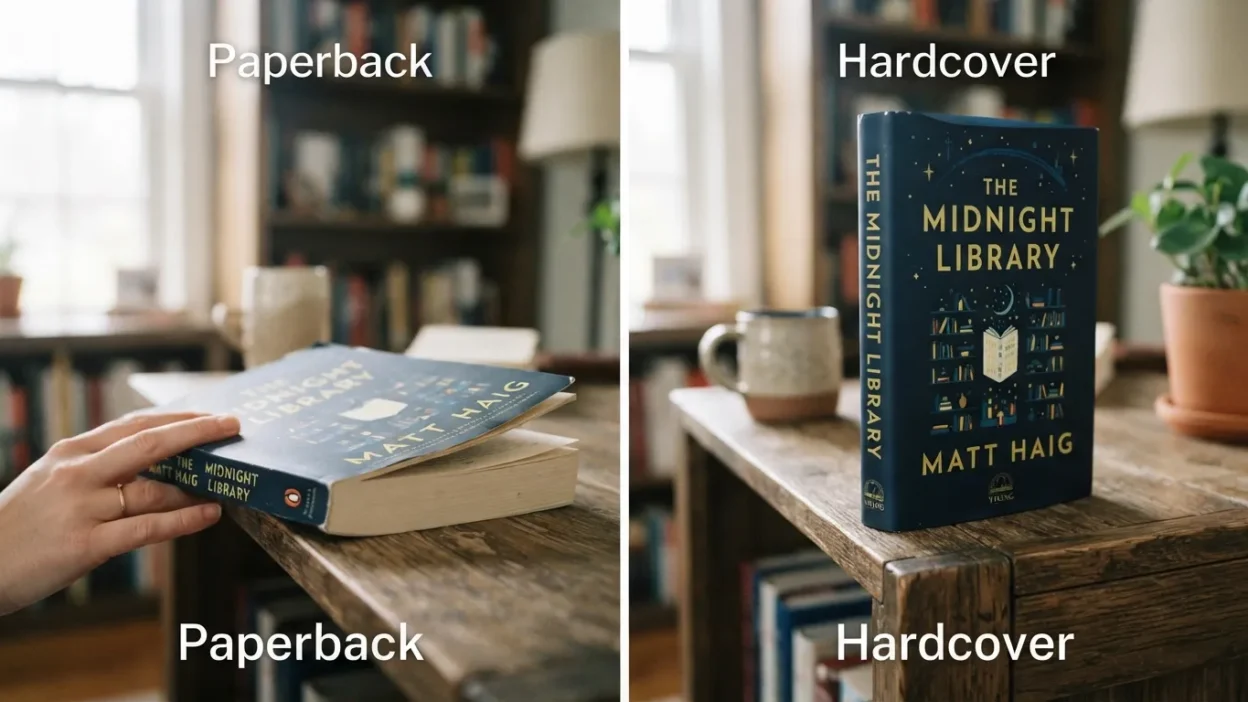
The main difference between paperback vs hardcover books is the cover and binding. Paperback books have flexible paper or cardstock covers, making them lighter, cheaper, and easier to carry.
Hardcover books have rigid protective boards, making them sturdier and more suitable for gifts, collections, and long-term use. The best choice depends on your budget, reading habits, and preferences.
- Paperback: Best for affordable reading, travel, and everyday use.
- Hardcover: Best for durability, gifts, and collecting favorite books.
- Price: Hardcovers usually cost more because of their materials and construction.
- Reading comfort: Paperbacks are lighter, while hardcovers offer more physical protection.
- Best choice: Buy paperback to save money or hardcover when appearance and durability matter more.
What Is the Difference Between Paperback and Hardcover?
The biggest difference between paperback and hardcover books is how they are made. Both formats contain printed pages, but their covers provide different levels of protection and affect their weight, price, and appearance.
A paperback uses a flexible cover, while a hardcover uses rigid boards. These construction differences explain why the two editions of the same book can feel very different in your hands.
What Is a Paperback Book?
A paperback book has a flexible cover made from thick paper or cardstock. The pages are commonly attached to the spine with adhesive, a method often called perfect binding.
Paperbacks are popular because they are generally affordable, lightweight, and convenient to carry. You can easily put one in a backpack, purse, or suitcase.
There are also different types of paperbacks. Mass-market paperbacks are typically smaller, while trade paperbacks are often larger and may have a more substantial feel.
Best for: Everyday reading, students, commuters, travelers, and readers who want to build a library without spending too much.
What Is a Hardcover Book?
A hardcover book, also called a hardback, has a rigid cover made from thick boards wrapped in printed paper, cloth, or another covering material.
Many hardcover editions include a removable dust jacket. This paper cover displays the artwork and title while helping protect the boards underneath.
Hardcovers are often chosen for their sturdy construction and polished appearance. However, not every hardcover uses sewn binding; some are glued, too. The actual durability depends on the quality of the binding, paper, and materials.
Best for: Collectors, gift buyers, libraries, reference books, and readers who want a more substantial edition.
Paperback vs Hardcover: Side-by-Side Comparison
Here is a quick comparison to help you decide which format fits your needs.
| Feature | Paperback | Hardcover |
| Cover | Flexible paper or cardstock | Rigid protective boards |
| Price | Usually cheaper | Usually more expensive |
| Weight | Lighter | Heavier |
| Durability | More prone to bends and creases | Better cover protection |
| Portability | Easy to carry | Less convenient for travel |
| Appearance | Simple and practical | Often more premium |
| Storage | Takes less space in many cases | May require more shelf space |
| Gifting | Good for casual gifts | Great for special occasions |
| Collecting | Suitable for everyday editions | Often preferred for special editions |
| Best use | Daily reading and travel | Display, gifting, and frequent reference |
These are general differences, not strict rules. Book size, paper quality, binding construction, and publisher choices can change the experience.
Paperback vs Hardcover: Pros and Cons
Both formats have advantages. Your ideal choice depends on what matters most when you buy a book.
Advantages and Disadvantages of Paperback
Pros
- Lower price: Paperbacks usually cost less than comparable hardcovers.
- Easy to carry: Their lighter construction makes them convenient for travel.
- Comfortable for casual reading: They are often easier to hold during a commute or while relaxing.
- Space-saving: Many paperback editions fit easily into smaller bags and bookshelves.
Cons
- Flexible covers: The covers can bend, crease, or develop worn corners.
- Spine damage: Repeated use may cause creases or damage to the spine.
- Less protection: The pages and binding may be more exposed to everyday wear.
- Less substantial appearance: Some readers prefer the look of a hardcover on a shelf.
Paperbacks are an excellent option when you care more about enjoying the story than preserving a pristine copy.
Advantages and Disadvantages of Hardcover
Pros
- Sturdy cover: Rigid boards provide better protection against bending.
- Premium appearance: Hardcovers often look attractive in a home library.
- Gift-friendly: They can make a thoughtful choice for birthdays, holidays, and special occasions.
- Long-term use: A well-made hardcover can withstand repeated handling.
Cons
- Higher price: The additional materials and binding work generally increase the cost.
- More weight: Carrying a large hardcover can become uncomfortable.
- Less flexible: It may be harder to read while standing or traveling.
- More storage space: Larger dimensions can make some editions harder to store.
Hardcovers are worth considering when protection and presentation matter more than portability or price.
Why Are Hardcover Books More Expensive?
Hardcover books usually cost more because they require rigid boards and additional cover materials. Their production process can also involve extra binding and finishing steps.
Several factors influence the price:
- Materials: Rigid boards and optional dust jackets add to production costs.
- Binding: Hardcover construction generally requires more work than a basic paperback binding.
- Book design: Special finishes, embossed lettering, and decorative covers may increase the prie.
- Edition type: Collectible or limited editions may cost more because of their design, scarcity, or demand.
- Release timing: A new title may initially be available only in hardcover, limiting cheaper print options until other editions appear.
Not every hardcover is expensive, and not every paperback is cheap. Illustrations, page count, publisher pricing, and demand also affect retail prices.
Money-saving tip: If you do not need a book immediately, compare prices across editions. A paperback, used copy, or library loan may be a better choice for your budget.
Which Book Format Is Better for Reading?
Neither format is automatically better for every reader. The right option depends on where you read, how long you read, and how you handle your books.
Choose paperback if you:
- Read on buses, trains, or airplanes.
- Prefer holding a lighter book for long periods.
- Want to buy several books on a limited budget.
- Do not mind minor wear from regular use.
Choose hardcover if you:
- Want a sturdy copy for repeated reading.
- Prefer a more substantial book in your hands.
- Enjoy displaying books on shelves.
- Want to give someone a book as a special gift.
For example, imagine you want to read a 350-page mystery novel during your daily commute. A paperback may be more practical because it is easier to carry.
However, if you are buying a beautifully illustrated book for a family member, a hardcover may offer the presentation and protection you want.
Remember that reading comfort also depends on font size, page layout, paper quality, and the book’s overall weight. The cover alone does not determine the entire reading experience.
Why Do Hardcover Books Often Release First?
Some publishers release new books in hardcover before offering a paperback edition. This approach gives readers who want a new release immediately an option to purchase it while the publisher prepares or schedules other formats.
Hardcovers can also serve as premium editions for dedicated fans, collectors, and gift buyers.
A paperback may follow later, but there is no universal release schedule. Some books launch in paperback first, and others are available in several formats at the same time.
If you are waiting for a paperback version to save money, check the publisher’s announcements or the retailer’s listing. Do not assume that every hardcover will eventually receive a paperback edition.
Paperback vs Hardcover: Which Should You Choose?
Use this simple guide to make your decision.
| Your priority | Recommended format |
| Saving money | Paperback |
| Traveling with books | Paperback |
| Reading during a commute | Paperback |
| Buying multiple novels | Paperback |
| Giving a special gift | Hardcover |
| Building a display collection | Hardcover |
| Protecting a frequently used reference book | Hardcover |
| Getting a new release immediately | Whichever edition is available |
| Finding a collectible edition | Compare the specific editions |
If you are still unsure, think about what you want from the book. If your goal is to read and enjoy it at the lowest reasonable cost, paperback is often the practical choice.
If you want a book that looks special and offers a more protective cover, hardcover may be worth the extra expense.
You can also own both editions of a favorite title. Keep a paperback for casual reading and a hardcover for display or collecting.
FAQs:
Is paperback the same as softcover?
Yes. Paperback and softcover generally refer to the same type of book: one with a flexible cover rather than rigid boards. The terms are commonly used interchangeably in the United States. Hardcover and hardback are also equivalent terms for books with rigid covers.
Which lasts longer, paperback or hardcover?
A well-made hardcover will generally withstand cover bending and everyday handling better than a comparable paperback. However, its lifespan depends on binding quality, materials, storage conditions, and care. A poorly made hardcover can deteriorate faster than a well-made paperback.
Is hardcover worth the extra money?
Hardcover is worth the extra cost if you value durability, presentation, or collecting. If you mainly want to read a novel once and pass it along, paperback may provide better value. Compare the actual prices and construction before deciding.
Do paperback and hardcover editions contain the same content?
Often, yes. Many editions contain the same main text, but this is not guaranteed. Some hardcover editions include illustrations, bonus chapters, author notes, or other extras. Publishers may also revise a book between editions, so check the edition details if the exact content matters to you.
Conclusion:
The choice between paperback vs hardcover comes down to cost, durability, portability, and personal preference. Paperback books are usually cheaper and lighter, making them ideal for everyday reading. Hardcover books provide a sturdier cover and a more substantial appearance, making them attractive for gifts and collections.
Choose paperback for affordability and convenience, or hardcover for protection and presentation. Neither format is best for everyone. The best book is the one that fits your reading habits, budget, and goals.

I am George R. R. Martin, an American author best known for A Song of Ice and Fire and its world of unforgettable characters.
I share my writing journey and literary insights with readers on Elitenamez.com.


