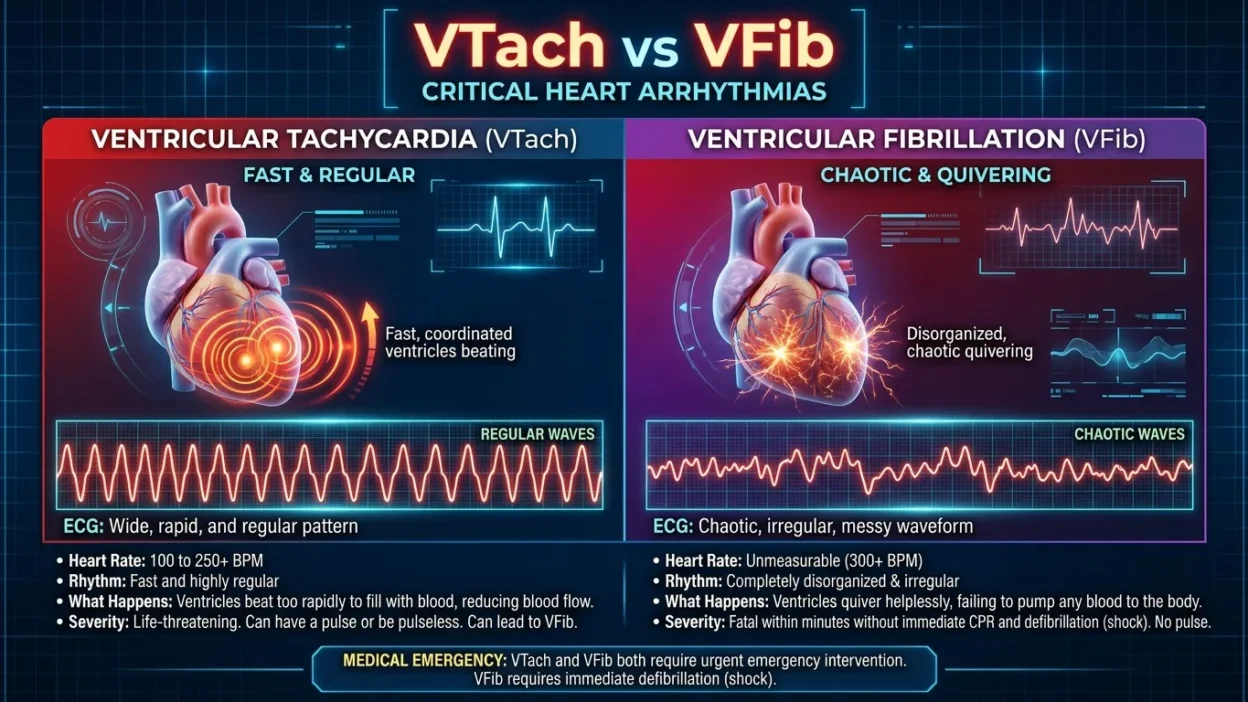
VFib vs VTach refers to two dangerous abnormal heart rhythms that begin in the heart’s lower chambers.
Ventricular fibrillation (VFib) causes chaotic electrical activity that prevents the heart from pumping blood effectively.
Ventricular tachycardia (VTach) causes an abnormally fast rhythm that may still produce a pulse. Both can lead to cardiac arrest and require urgent medical attention.
Key Takeaways
- VFib makes the ventricles quiver instead of pumping blood, usually causing cardiac arrest.
- VTach makes the ventricles beat too quickly; its severity depends on the rhythm and its effect on circulation.
- Both rhythms can cause dizziness, fainting, chest discomfort, or sudden collapse.
- VFib and certain forms of VTach require immediate defibrillation and emergency treatment.
- If someone collapses and is unresponsive with absent or abnormal breathing, call 911, begin CPR, and use an AED as soon as possible.
What Is the Difference Between VFib and VTach?
VFib and VTach are types of ventricular arrhythmias. An arrhythmia is an abnormal heart rhythm that develops when the heart’s electrical signals do not work as expected.
Your heart has four chambers. The two lower chambers, called ventricles, pump blood to your lungs and the rest of your body. When their electrical activity becomes abnormal, the heart may struggle to maintain adequate blood flow.
The main difference is how the ventricles behave.
- VFib: The electrical signals become chaotic, causing the ventricles to quiver without effectively pumping blood.
- VTach: The electrical signals make the ventricles beat very rapidly. The heart may still pump blood, but its ability to circulate blood can be severely reduced.
Both conditions can be life-threatening. The American Heart Association identifies VFib as one of the most serious abnormal heart rhythms because it can quickly cause sudden cardiac arrest.
What Is VFib?
Ventricular fibrillation
Ventricular fibrillation, commonly called VFib or V-fib, occurs when electrical impulses spread through the ventricles in a disorganized way.
Instead of contracting normally, the heart’s lower chambers quiver. Blood circulation stops or becomes insufficient, and the person typically loses consciousness within seconds.
VFib is a medical emergency. Without immediate treatment, it can be fatal within minutes.
Common warning signs before collapse may include chest pain, a racing or irregular heartbeat, dizziness, nausea, and shortness of breath. However, a person may collapse with little or no warning.
Treatment generally requires CPR and rapid defibrillation to help restore an effective heart rhythm.
What Is VTach?
Ventricular tachycardia
Ventricular tachycardia, commonly called VTach or V-tach, is an abnormally fast heart rhythm that begins in the ventricles.
The rapid rate leaves less time for the heart chambers to fill with blood between beats. As a result, the heart may not pump enough blood to the brain and other organs.
Some brief episodes stop on their own, while others persist and become dangerous. Sustained VTach generally means the rhythm lasts at least 30 seconds or requires earlier intervention because of instability.
Possible symptoms include palpitations, dizziness, chest pain, shortness of breath, and fainting. Severe VTach can cause cardiac arrest, even when it initially produces a pulse.
VFib vs VTach: Key Differences at a Glance
The following table summarizes the most important differences between the two rhythms.
| Feature | VFib | VTach |
| Full name | Ventricular fibrillation | Ventricular tachycardia |
| Electrical activity | Chaotic and disorganized | Rapid ventricular rhythm |
| Heart action | Ventricles quiver | Ventricles beat rapidly |
| Effective pumping | Absent | May be present or severely reduced |
| Pulse | Absent in cardiac arrest | May be present or absent |
| Common symptoms | Sudden collapse and unconsciousness | Palpitations, dizziness, chest pain, fainting |
| ECG appearance | Chaotic waveform without organized QRS complexes | Typically rapid, wide QRS complexes |
| Emergency treatment | CPR and rapid defibrillation | Depends on pulse and stability; may include cardioversion, defibrillation, and medication |
| Major danger | Rapid cardiac arrest | Can progress to cardiac arrest or VFib |
Important: These rhythms cannot be reliably distinguished by symptoms alone. Medical professionals use an ECG or cardiac monitor, together with the patient’s condition, to identify the rhythm and guide treatment.
Symptoms of VFib vs VTach
Symptoms can overlap, but the way each rhythm affects circulation often differs.
Common Symptoms of VTach
VTach may cause symptoms ranging from mild discomfort to sudden collapse. The experience depends on how fast the rhythm is, how long it lasts, and whether the person has underlying heart disease.
Common symptoms include:
- A rapid, pounding, or fluttering heartbeat
- Dizziness or lightheadedness
- Shortness of breath
- Chest pain or pressure
- Weakness or unusual fatigue
- Fainting or near-fainting
Some people have few noticeable symptoms during a short episode. That does not automatically mean the rhythm is harmless.
Sustained VTach, or VTach accompanied by fainting, chest pain, severe breathing difficulty, or signs of poor circulation, requires emergency evaluation.
Warning Signs of VFib
VFib usually causes a much more immediate loss of effective circulation.
Possible signs include:
- Sudden collapse
- Loss of consciousness
- No normal breathing or only gasping
- No detectable pulse when assessed by a trained responder
Some people experience chest discomfort, dizziness, or palpitations shortly before VFib begins. However, symptoms may not provide enough warning to seek help before collapse.
If someone suddenly becomes unresponsive and is not breathing normally, do not wait to determine whether the cause is VFib or VTach. Call 911, start CPR, and use an AED as soon as one is available.
VFib vs VTach on an ECG
An electrocardiogram (ECG or EKG) records the electrical activity of the heart. It helps healthcare professionals distinguish ventricular fibrillation from ventricular tachycardia.
VFib ECG
The tracing typically shows chaotic, irregular electrical activity without recognizable, organized QRS complexes. This reflects the ventricles’ inability to contract in a coordinated way.
VTach ECG
The tracing commonly shows a rapid rhythm with wide QRS complexes. The pattern may be relatively regular or vary, depending on the type of VTach.
ECG interpretation requires clinical expertise. These descriptions explain typical patterns, not a method for diagnosing yourself or another person from an image. In an emergency, treatment decisions also depend on whether a pulse is present and whether circulation is stable.
Which Is More Dangerous: VFib or VTach?
VFib is generally more immediately dangerous because it prevents the ventricles from pumping blood effectively and usually causes cardiac arrest.
However, VTach can also be fatal. A sustained or unstable episode may sharply reduce blood flow, cause unconsciousness, or progress to VFib.
The practical distinction is this:
- VFib: The heart cannot pump effectively, so immediate CPR and defibrillation are critical.
- VTach with a pulse: The person may still have circulation, but urgent assessment and treatment may be necessary.
- VTach without a pulse: This is cardiac arrest and requires immediate CPR and defibrillation.
Neither rhythm should be dismissed as harmless based on its name or the person’s initial appearance.
Causes and Risk Factors
VFib and VTach share several possible causes because both involve abnormal electrical activity in the ventricles.
Common causes and risk factors include:
- Heart attack: Damage from reduced blood flow can disrupt the heart’s electrical system.
- Coronary artery disease: Narrowed heart arteries can limit oxygen delivery to the heart muscle.
- Cardiomyopathy: Changes in heart muscle structure or function may increase the risk of ventricular arrhythmias.
- Electrolyte imbalances: Abnormal potassium or magnesium levels can interfere with electrical signaling.
- Certain medications or drugs: Some substances can trigger dangerous rhythm disturbances.
- Inherited or congenital heart conditions: Some electrical disorders and structural abnormalities increase the risk.
- Previous ventricular arrhythmias: A prior episode may indicate a higher risk of recurrence.
The exact cause varies from person to person. Healthcare professionals may investigate with blood tests, ECG monitoring, imaging, and other cardiac tests after stabilizing the patient.
How Are VFib and VTach Treated?
Treatment depends on the heart rhythm, whether a pulse is present, and whether the person is stable.
Emergency Treatment for VFib
VFib requires immediate emergency treatment.
- Call 911. Put the phone on speaker if possible and follow the dispatcher’s instructions.
- Begin CPR. If the person is unresponsive and not breathing normally, start chest compressions. Push hard and fast in the center of the chest, at a rate of 100–120 compressions per minute.
- Use an AED. Turn it on, attach the pads, and follow its voice prompts. The device will determine whether a shock is advised.
- Continue until help arrives. Follow AED prompts and dispatcher instructions.
Do not delay CPR while trying to identify the exact heart rhythm. If you are untrained, hands-only CPR is appropriate for an adult who suddenly collapses and is not breathing normally.
Emergency Treatment for VTach
VTach treatment depends on the person’s condition.
- VTach with a pulse and serious instability: Emergency clinicians may perform synchronized cardioversion, which delivers a timed electrical shock to restore a safer rhythm.
- Pulseless VTach: CPR and defibrillation are required.
- Stable VTach: Clinicians may use appropriate antiarrhythmic medication and investigate the cause.
- Prevention of future episodes: Depending on the underlying condition, treatment may include medication, catheter ablation, or an implantable cardioverter-defibrillator (ICD).
These treatments must be selected by qualified medical professionals. Do not attempt to treat a suspected dangerous arrhythmia at home.
Can VTach Turn Into VFib?
Yes. VTach can sometimes deteriorate into VFib, particularly when the rhythm is sustained or the heart is affected by serious underlying disease.
When VTach becomes more disorganized, the ventricles may lose their ability to contract in a coordinated way. If VFib develops, effective pumping stops and cardiac arrest can occur.
This is one reason medical professionals take potentially dangerous VTach seriously, even when the person initially has a pulse.
Early recognition, appropriate emergency treatment, and follow-up with a heart specialist can help manage the risk.
Frequently Asked Questions
1. What is the main difference between VFib and VTach?
VFib causes chaotic electrical activity that makes the ventricles quiver rather than pump blood effectively. VTach causes a very fast rhythm originating in the ventricles. VTach may initially produce a pulse, while VFib typically causes cardiac arrest.
2. Are VFib and VTach both shockable rhythms?
Yes. VFib and pulseless VTach are both shockable rhythms, meaning an AED or defibrillator can deliver a shock to help restore an effective heart rhythm. VTach with a pulse may require a different approach, such as synchronized cardioversion, depending on the patient’s stability.
3. Can you survive VFib or VTach?
Yes. Survival is possible, especially when the rhythm is recognized and treated promptly. VFib and pulseless VTach require immediate emergency response, CPR, and rapid defibrillation when indicated. Outcomes depend on several factors, including the underlying cause, how quickly treatment begins, and the person’s overall health.
4. Is VFib the same as a heart attack?
No. A heart attack occurs when blood flow to part of the heart muscle is blocked or severely reduced. VFib is a dangerous electrical rhythm disorder that prevents the ventricles from pumping effectively. A heart attack can trigger VFib, but the two conditions are not the same.
5. What should you do if someone collapses from a suspected heart rhythm problem?
Call 911 immediately if someone is unresponsive and not breathing normally. Begin CPR and use an AED as soon as possible, following its prompts. Do not wait for a healthcare professional to confirm whether the rhythm is VFib or VTach before taking these emergency steps.
Conclusion:
Understanding VFib vs VTach helps explain two serious heart rhythm disorders that can interfere with blood circulation. VFib causes the ventricles to quiver without effective pumping, while VTach causes an abnormally fast ventricular rhythm that may or may not maintain adequate circulation.
Both conditions can become life-threatening, and VTach can progress to VFib. The key is recognizing an emergency, calling 911, starting CPR when indicated, and using an AED promptly.
If you have experienced unexplained palpitations, fainting, or a diagnosed ventricular arrhythmia, consult a qualified healthcare professional about evaluation and prevention. Early medical assessment can help identify the cause and guide appropriate care.

I am Ernest Hemingway, a celebrated American author known for my simple, powerful writing style and unforgettable stories.
I share my literary journey, life, and writing insights with readers on Elitenamez.com.