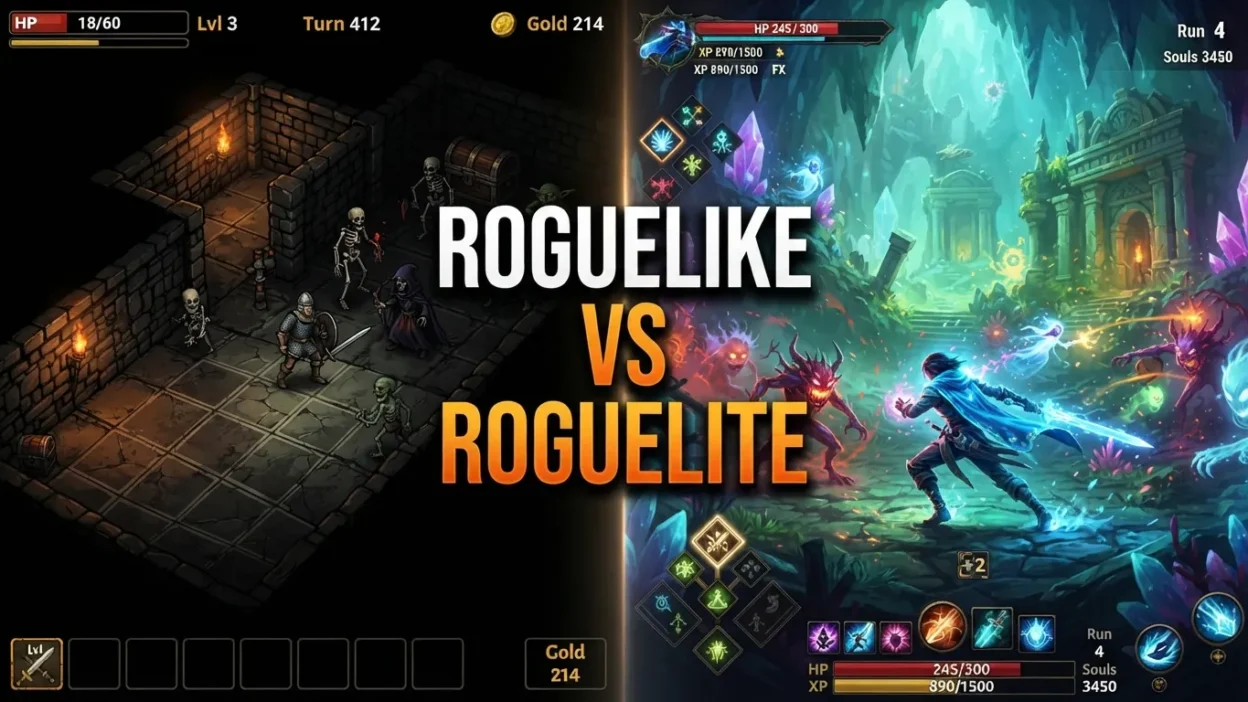
The main difference between a roguelike and a roguelite is how closely the game follows the classic Rogue formula and what carries over between runs.
Traditional roguelikes usually feature permadeath, randomized environments, turn-based gameplay, and little or no permanent character progression.
Roguelites borrow these ideas but often add persistent upgrades, unlocks, story progress, or different styles of combat.
Key Takeaways
- Roguelikes closely follow the design ideas associated with the original Rogue.
- Roguelites borrow roguelike mechanics but usually offer persistent progression between runs.
- Permadeath and randomized runs are common to both.
- The Berlin Interpretation provides a historical framework for understanding traditional roguelikes.
- Games such as Hades and Dead Cells are commonly described as roguelites, although modern gaming terminology is not completely standardized.
What Is a Roguelike?
A roguelike is a game inspired strongly by Rogue, the influential dungeon-crawling game that helped establish the genre. The classic formula focuses on unpredictable runs, dangerous exploration, resource management, and permanent death.
In a traditional roguelike, dying usually ends the current character’s run. You start again with a new attempt rather than continuing from a checkpoint with the same equipment.
The important part is not simply that the game is difficult. A roguelike is built around making decisions in situations that can change from one run to another.
The classic roguelike formula
Traditional roguelikes commonly include several of these features:
- Randomly generated environments
- Permadeath
- Turn-based gameplay
- Grid-based movement
- Resource management
- Exploration and discovery
- Character development during a run
- Limited or no permanent power progression between runs
Games such as NetHack, Dungeon Crawl Stone Soup, Angband, and Caves of Qud are often associated with the traditional side of the genre.
The original Rogue itself used randomly generated rooms and permanent death, creating a different experience with each attempt. That basic design became the foundation for an entire family of games.
The Berlin Interpretation
The definition of a roguelike becomes more complicated when you look at genre history.
In 2008, developers and players at the International Roguelike Development Conference in Berlin developed what became known as the Berlin Interpretation. It was an attempt to describe the characteristics that make a game strongly resemble the traditional roguelike genre.
Its high-value factors included things such as random environment generation, permadeath, turn-based play, grid-based movement, exploration, resource management, and other characteristics associated with classic roguelikes.
However, the Berlin Interpretation was never meant to be a universal rulebook that developers must obey. It is better understood as a framework for discussing how closely a game fits the traditional roguelike model.
That distinction matters because modern games have stretched the meaning of the word considerably.
What Is a Roguelite?
A roguelite is a game that takes important ideas from roguelikes but changes or relaxes some of the traditional rules.
The most useful difference for players is persistent progression.
Imagine you complete a run, die, and return to the starting area. In a traditional roguelike, you may lose nearly everything from that character. In a roguelite, the game may let you keep currency, unlock weapons, permanent abilities, story progress, or other rewards.
You still have to begin another run, but the overall game has moved forward.
How meta-progression works
This permanent development is often called meta-progression.
For example, imagine a game where you earn 100 coins during a failed run. After dying, you spend those coins to permanently unlock a new weapon. Your next run starts with access to that weapon even though your previous run has ended.
That is a classic roguelite-style progression loop.
The important point is that meta-progression does not always mean simply becoming stronger. Permanent unlocks can also provide new characters, weapons, abilities, areas, story events, or gameplay options.
This gives failure a different purpose. You may lose the run, but you still receive something that can affect future attempts.
Roguelike vs Roguelite: Key Differences
| Feature | Roguelike | Roguelite |
|---|---|---|
| Inspiration | Closely follows Rogue | Borrows roguelike ideas |
| Permadeath | Usually central | Usually present |
| Randomized runs | Common | Common |
| Permanent upgrades | Usually absent or limited | Common |
| Combat | Traditionally turn-based | Often real-time, but varies |
| Grid movement | Common in traditional examples | Not required |
| Progress after death | Mostly player knowledge | Often includes permanent rewards |
| Main appeal | Mastery and decision-making | Replayability plus progression |
| Genre boundaries | More traditional | More flexible |
The table shows why the terms can be confusing.
A game does not become a roguelite simply because it has fast combat. Likewise, a game is not automatically a roguelike because it randomly generates its levels.
The overall design matters.
Roguelike vs Roguelite Examples
Traditional roguelike examples
NetHack is one of the classic examples. It emphasizes exploration, resource management, unpredictable situations, and permanent death.
Dungeon Crawl Stone Soup is another well-known traditional roguelike. Its gameplay focuses heavily on strategic decisions, character development during a run, and surviving increasingly dangerous encounters.
Caves of Qud combines traditional roguelike ideas with a deep science-fantasy setting and extensive character systems.
These games demonstrate the older meaning of roguelike, where the structure of the original genre remains highly important.
Roguelite examples
Hades uses randomized runs, death, different builds, and repeated attempts, but it also provides permanent progression and continuing story development.
Dead Cells combines fast action-platforming with randomized runs and permanent unlocks. Resources earned during runs can contribute to long-term progression.
Rogue Legacy is another clear example of a game built around repeated attempts while allowing certain improvements and unlocks to carry forward.
These games show how developers can take the basic roguelike loop and combine it with other genres and progression systems.
Is Hades a Roguelike or Roguelite?
This is one of the most common sources of confusion.
The safest answer is: Hades is commonly described as a roguelite, although its developers use “rogue-like” as a broader description.
Supergiant Games describes Hades as a rogue-like dungeon crawler and explains that the game uses randomized runs, repeated deaths, and knowledge carried into future attempts. It also includes permanent progression systems and difficulty options.
That is why many players use roguelite as the more precise label when comparing it with traditional roguelikes.
The disagreement is mostly about terminology, not gameplay. Everyone can agree that Hades uses the core run-based structure associated with the genre. The question is simply how narrowly you want to define “roguelike.”
Are Roguelikes Harder Than Roguelites?
Not necessarily, but traditional roguelikes can feel less forgiving because they usually provide less permanent assistance after failure.
If you die in a traditional roguelike, your next character may begin with no permanent power gained from the previous attempt. Your biggest advantage is your own knowledge.
Roguelites can soften that experience by giving you permanent upgrades or unlocks.
However, that does not mean every roguelite is easy.
A roguelite can remain extremely challenging even after dozens of hours. Developers can also use difficulty modifiers, stronger enemies, limited resources, or increasingly demanding areas to keep experienced players challenged.
So the better distinction is not easy versus hard. It is what kind of progress the game gives you after failure.
Which Should You Play?
Choose a roguelike if you enjoy:
- Strategic decision-making
- High-risk gameplay
- Learning through failure
- Traditional dungeon crawling
- Turn-based or grid-based systems
- Winning primarily through player knowledge and skill
Choose a roguelite if you prefer:
- Fast or modern gameplay
- Permanent upgrades
- Unlockable weapons and abilities
- Story progression between runs
- A mixture of genres
- A sense that every failed attempt still moves the game forward
Of course, you do not have to choose one side permanently. Many modern games borrow from both approaches.
The labels are useful for setting expectations, but they are not strict boxes that every game fits perfectly.
Frequently Asked Questions
What makes a game a roguelike?
A traditional roguelike usually combines features associated with Rogue, including procedural or random environment generation, permadeath, turn-based and grid-based gameplay, exploration, and resource management. The Berlin Interpretation is one historical framework used to describe these characteristics, although modern usage of “roguelike” is broader.
What does roguelite mean?
Roguelite generally refers to a game that uses important roguelike ideas while adding or changing other elements. Persistent progression is one of its most common features. Players may keep currencies, unlocks, weapons, abilities, characters, or story progress after a run ends.
Is Dead Cells a roguelike or roguelite?
Dead Cells is commonly categorized as a roguelite because it combines randomized runs and permadeath with permanent unlocks and progression. It also blends roguelike ideas with fast-paced action-platforming and Metroidvania-style exploration.
Do roguelikes have permanent upgrades?
Traditional roguelikes generally do not use permanent character-power upgrades that carry from one failed run into the next. Instead, the player’s knowledge and skill improve over time. However, modern usage of “roguelike” is broader, so some games labeled roguelikes may include persistent progression.
Conclusion:
The simplest way to understand roguelike vs roguelite is to look at what happens after you die.
A traditional roguelike usually asks you to start again with the character’s run effectively wiped clean, while a roguelite often lets you carry some form of permanent progression into the next attempt.
But the terms are not perfectly standardized. The Berlin Interpretation describes the traditional roguelike model, while modern games continue to blend roguelike mechanics with action, platforming, RPGs, and other genres.
So when choosing a game, look beyond the label. Check how death works, what carries over, and how the game expects you to progress.

I am Ernest Hemingway, a celebrated American author known for my simple, powerful writing style and unforgettable stories.
I share my literary journey, life, and writing insights with readers on Elitenamez.com.