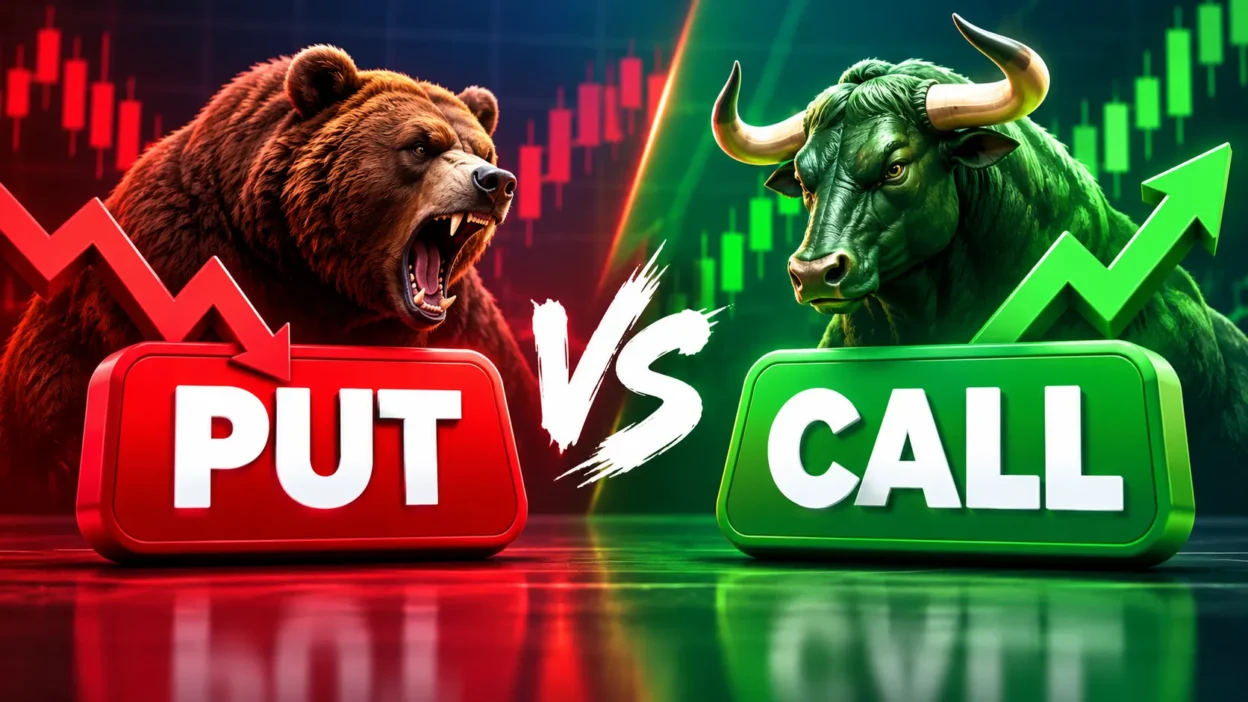
A call option gives the buyer the right, but not the obligation, to buy an underlying asset at a set strike price.
A put option gives the buyer the right, but not the obligation, to sell it. In simple terms, calls generally benefit from rising prices, while puts generally benefit from falling prices.
However, buying and selling options creates very different risk profiles.
Key Takeaways
- A call gives the buyer the right to buy; a put gives the buyer the right to sell.
- Call buyers generally expect the underlying asset to rise, while put buyers generally expect it to fall.
- The premium, strike price, and expiration date all affect an option’s value.
- Buyers can generally lose the premium paid if the option expires worthless.
- Selling options can create substantially greater obligations and risks than simply buying them.
What Is the Difference Between a Put and a Call?
The easiest way to remember the difference is:
Call = right to buy.
Put = right to sell.
Both are types of options contracts. An option gives the buyer a right, but not an obligation, to transact at a specified strike price during a defined period or at expiration, depending on the contract’s exercise style.
The seller, often called the writer, takes on the corresponding obligation if the option is exercised and assigned. The buyer pays the seller a premium for the contract.
| Feature | Call Option | Put Option |
|---|---|---|
| Buyer has the right to | Buy | Sell |
| Typical buyer outlook | Bullish | Bearish |
| Strike price | Price to buy | Price to sell |
| Buyer pays | Premium | Premium |
| Benefits when underlying price generally | Rises | Falls |
| Common use | Upside exposure or hedging | Downside protection or bearish exposure |
This is the basic put vs call comparison, but there is an important detail: the word “buy” or “sell” before the option matters.
A trader who buys a put is generally bearish. But someone who sells a put may have a bullish or neutral outlook. The same idea applies to calls.
How Call Options Work
A call option gives the buyer the right to purchase the underlying asset at the strike price.
Suppose a stock is trading at $50, and you buy a call with a $55 strike price. You pay a premium for that right.
If the stock later rises substantially, the call can become more valuable because you have the right to buy at $55 while the market price is higher.
For example, imagine the stock reaches $70 at expiration. Ignoring transaction costs, the call has $15 of intrinsic value per share because the stock is $15 above the $55 strike.
However, that does not automatically mean you made $15 per share. You also paid a premium.
Call Option Example
Suppose:
- Stock price: $50
- Call strike: $55
- Premium: $3 per share
- Contract size: 100 shares
The premium costs $300 for one contract if the contract represents 100 shares.
At expiration, the approximate break-even price for a purchased call is:
$55 strike + $3 premium = $58
If the stock finishes below $55, the call generally has no intrinsic value at expiration and may expire worthless. Your maximum loss as the buyer is generally the $300 premium paid, excluding transaction costs.
For standard U.S. equity options, contract terms should always be checked with your broker because contract specifications can vary by product. Investor.gov notes that an option quote includes important information such as the underlying security, expiration, strike price, option type, and premium.
How Put Options Work
A put option works in the opposite direction. It gives the buyer the right to sell the underlying asset at the strike price.
Imagine the same stock is trading at $50. You buy a put with a $45 strike and pay a $2 premium.
If the stock falls sharply, the right to sell at $45 may become valuable.
For example, if the stock falls to $30 at expiration, the put has $15 of intrinsic value per share. But you paid $2 for the option, so your approximate break-even level for a purchased put is:
$45 strike − $2 premium = $43
Below that level, the position has positive intrinsic value exceeding the premium, before considering transaction costs.
Put Option Example
Suppose:
- Stock price: $50
- Put strike: $45
- Premium: $2 per share
- Contract size: 100 shares
The option costs approximately $200 for one contract.
If the stock stays above $45 through expiration, the put may expire worthless. As the buyer, your maximum loss is generally the premium paid.
A put can also be used as a hedge. For example, an investor who owns shares might purchase a put to establish a minimum selling price for those shares, although the protection comes at the cost of the premium.
Put vs Call: Why the Premium Matters
One of the biggest beginner mistakes is looking only at the strike price.
An option’s premium is the price paid for the contract. It is influenced by factors such as the underlying price, strike price, time remaining, and volatility.
That means correctly predicting the direction of a stock is not always enough to make money.
For example, you could buy a call because you expect a stock to rise. If the stock rises only slightly, or takes too long to rise, the option may still lose value because of the premium and other pricing factors.
The same principle applies to puts.
This is why options are different from simply buying shares of a stock. With shares, there is no fixed expiration date. An option has a limited life, and its value can change before expiration.
Buying vs. Selling Calls and Puts
The simple rule “calls are bullish and puts are bearish” is useful for beginners, but it is incomplete.
There are four basic positions:
| Position | General outlook |
|---|---|
| Buy a call | Bullish |
| Buy a put | Bearish |
| Sell a call | Often neutral-to-bearish, depending on strategy |
| Sell a put | Often neutral-to-bullish, depending on strategy |
The risk can also change dramatically.
When you buy an option, the premium paid generally represents the maximum loss if the option expires worthless. When you sell an option, however, you take on an obligation and may face much greater losses depending on the strategy.
For example, an uncovered call seller can face theoretically unlimited losses if the underlying stock rises substantially. A put seller can also face significant losses if the underlying falls sharply.
FINRA warns that options are complex instruments and that options trading requires specific approval from a brokerage firm.
When Should You Consider a Call or Put?
There is no universally “better” choice between a put and a call. The appropriate contract depends on what you are trying to accomplish.
If You Expect a Strong Price Increase
A purchased call may fit a bullish thesis because its value can benefit from a rising underlying price.
If You Expect a Significant Price Decline
A purchased put may fit a bearish thesis because its value can benefit from a falling underlying price.
If You Own Shares and Want Downside Protection
A put may be used as a hedge. You pay a premium in exchange for the right to sell at the selected strike.
If You Own Shares and Want Potential Income
A covered call can be used by some investors to generate premium income while accepting an obligation to sell the shares at the strike if assigned.
The important point is that the option type should follow the strategy and risk objective, not simply a prediction about tomorrow’s stock price.
Common Mistakes Beginners Make
Choosing an option only because the premium looks cheap.
A low-priced option is not automatically a low-risk opportunity. Its strike, expiration, probability, liquidity, and volatility all matter.
Ignoring expiration.
An option has a defined lifespan. Being correct about direction after expiration does not help an option that has already expired.
Forgetting the premium when calculating profit.
A call can have intrinsic value while still producing a loss after accounting for the premium paid.
Confusing buying with selling.
The risk profile of buying one option is very different from writing one.
Trading without understanding assignment.
Option sellers can have obligations if their contracts are assigned. Understanding exercise and assignment is essential before selling options. OCC’s educational material specifically distinguishes the rights of option holders from the obligations of option writers.
Put vs Call FAQs
Is a call bullish or bearish?
Buying a call is generally considered a bullish position because the buyer benefits when the underlying asset rises enough to overcome the premium paid. However, calls can also be used in more complex strategies, so the word “call” alone does not always mean a trader is bullish.
Is a put bullish or bearish?
Buying a put is generally considered bearish because the buyer benefits from a decline in the underlying asset. Puts can also be used for portfolio protection, meaning an investor can purchase one even while remaining generally bullish on the stock they own.
Which is better, a put or a call?
Neither is automatically better. A call may make sense for a bullish strategy, while a put may make sense for a bearish strategy or downside hedge. The decision should also account for the strike price, premium, expiration, volatility, liquidity, and maximum potential loss.
Can you lose more than the premium on an option?
An option buyer can generally lose the entire premium paid if the option expires worthless. Option sellers can face substantially greater obligations. The exact risk depends on the position and strategy, which is why investors should understand the contract before trading it. OCC states that options involve risk and are not suitable for everyone.
Conclusion
The core difference in put vs call is simple: a call gives the buyer the right to buy, while a put gives the buyer the right to sell.
The harder part is understanding how premium, strike price, expiration, volatility, and buying versus selling affect the actual trade.
For beginners, the safest starting point is not choosing between a put and call based on a quick market prediction.
First understand the contract, calculate the maximum possible loss, and know exactly what happens if the option reaches expiration or is assigned.

I am George R. R. Martin, an American author best known for A Song of Ice and Fire and its world of unforgettable characters.
I share my writing journey and literary insights with readers on Elitenamez.com.