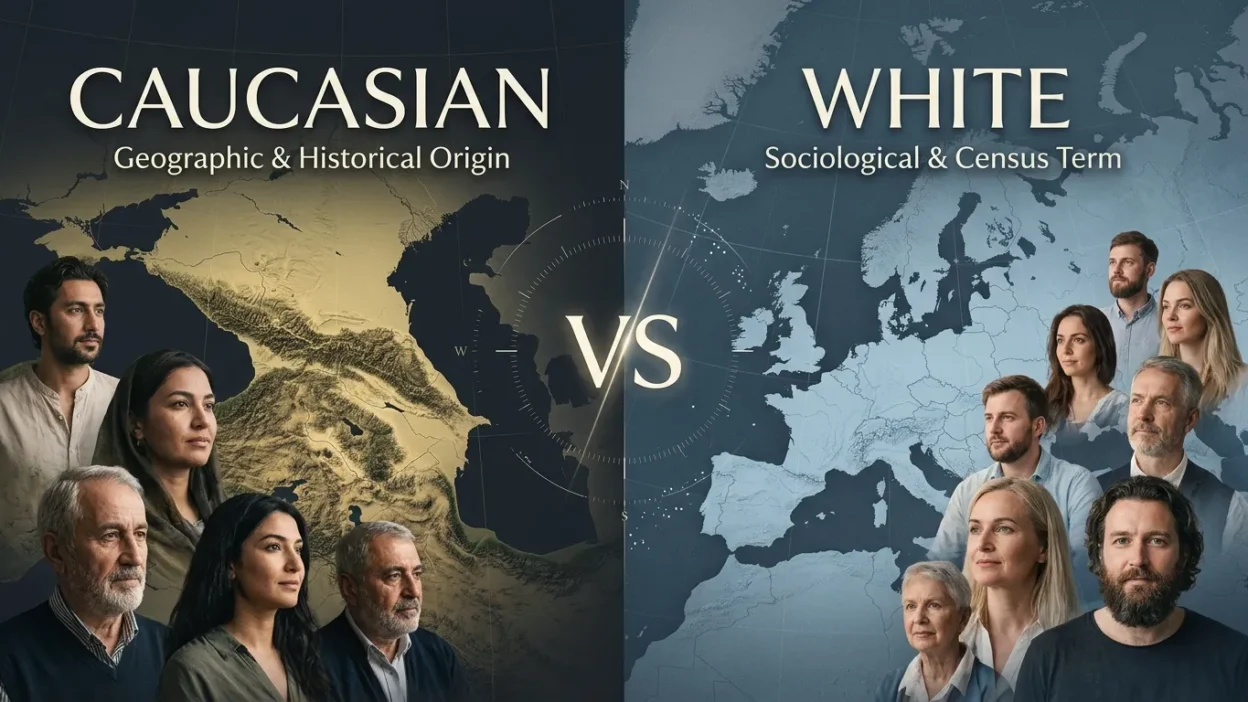
Caucasian and White are often used as synonyms in the United States, but they are not technically identical.
Caucasian” originally refers to people or things from the Caucasus region and later became part of an outdated racial classification.
White” is the more commonly accepted modern racial term in the U.S., although its official definition depends on the context.
Key Takeaways
- Caucasian originally relates to the Caucasus region, not all Europeans.
- “Caucasian” was later used as a broad racial label for people classified as White.
- Modern organizations, including the APA and CDC, generally discourage using “Caucasian” to mean White.
- White is a modern racial category, while European, Irish, Italian, or Polish describe ancestry or national/ethnic background.
- U.S. federal race and ethnicity standards were updated in 2024, including the creation of a separate Middle Eastern or North African (MENA) category.
What Does Caucasian Mean?
The word Caucasian has two important meanings, and this is where much of the confusion comes from.
In its literal geographic sense, Caucasian means something connected to the Caucasus, a region between the Black Sea and Caspian Sea. It can describe people, languages, cultures, or geography associated with that area.
But in the United States, “Caucasian” has also been used for many years as another word for a White person. That second meaning comes from an old racial classification system rather than from modern scientific racial categories.
Caucasian as a Geographic Term
If someone says Caucasian in a geographic or cultural context, they may be talking about people from the Caucasus.
The region includes countries and communities such as Georgia, Armenia, and Azerbaijan, as well as parts of southern Russia. The Caucasus is culturally and linguistically diverse, so “Caucasian” does not automatically mean “White American” or “European.”
This geographic meaning remains valid.
Caucasian as an Older Racial Classification
The racial meaning developed much later. In the late 18th century, German anthropologist Johann Friedrich Blumenbach used “Caucasian” as part of a classification of humanity into supposed racial groups.
That classification is no longer considered a scientifically valid way to divide humanity. Historical scholarship and modern professional guidance also point out that the term became connected with racial hierarchy and ideas of European or White superiority.
That history is one major reason modern style and health organizations recommend more precise language.
What Does White Mean?
White is a modern racial category used in the United States and other countries, although its exact definition can vary depending on the institution and purpose.
In the updated U.S. federal standards issued in 2024, the White category refers to people with origins in the original peoples of Europe, with examples including English, German, Irish, Italian, Polish, and Scottish origins.
This is different from saying that every person of European ancestry has the same ethnicity or culture.
For example:
- An Irish American may identify as White.
- An Italian American may identify as White.
- A Polish American may identify as White.
- A person may identify as White while also identifying with a particular European nationality or ancestry.
Race and ancestry therefore should not automatically be treated as the same thing.
Caucasian vs White: Key Differences
| Point | Caucasian | White |
|---|---|---|
| Original meaning | Connected to the Caucasus region | A racial category |
| Historical racial use | Yes | Yes |
| Modern U.S. usage | Often used as an older synonym for White | Common modern racial term |
| Scientific racial classification | Outdated | Race is understood as a social category, not a biological subdivision |
| Refers automatically to Europe? | No | Under current U.S. federal standards, the White category includes European origins |
| Recommended for modern U.S. writing? | Generally discouraged when meaning White | Generally preferred when a racial category is actually relevant |
The most important difference is precision.
“Caucasian” can mean something geographically specific, while “White” can describe a racial identity or category. Professional organizations increasingly recommend avoiding “Caucasian” when the intended meaning is simply White.
Why Is “Caucasian” Considered Outdated?
The term is considered outdated when it is used as a racial label because its history is tied to an old system of racial classification.
The American Psychological Association says that “Caucasian” should generally not be used as an alternative to “White” or “European.” The APA recommends using more specific descriptions of ancestry or region when possible.
The CDC similarly lists Caucasian among terms to avoid in its guidance on race and ethnicity terminology and recommends terms such as “White persons” when that category is appropriate.
Medical and scientific organizations have also moved away from the word. JAMA guidance notes that “Caucasian” historically referred to White people but is technically specific to people from the Caucasus region and should not be used as a general racial label.
This does not mean everyone who says “Caucasian” is using the word with bad intentions. It remains familiar in American English, and many people grew up hearing it used as a synonym for White.
The issue is mainly accuracy, history, and context.
Does Caucasian Mean European?
Not exactly.
The terms overlap in some everyday U.S. usage, but they describe different ideas.
European generally refers to geographic origin, nationality, or ancestry connected to Europe.
White refers to a racial category.
Caucasian, in its literal sense, refers to the Caucasus region. In its older racial sense, it was used much more broadly than the Caucasus itself.
For example, saying someone is Italian American gives information about ancestry or cultural background. Saying someone is White describes a racial identity or category. Saying someone is Caucasian could be interpreted as an older racial label or, depending on context, as a reference to the Caucasus.
When a more precise description is available, it is usually more useful to provide it.
Which Term Should You Use in the U.S.?
For most modern U.S. writing, White is preferable when you genuinely need to discuss race.
For ancestry, use a more specific term when it is relevant.
For example:
- “She is White” describes a racial category.
- “She is Italian American” describes a specific cultural or ancestral background.
- “Her family is from Georgia in the Caucasus” describes geographic origin.
The APA specifically recommends terms such as White, European, or European American depending on the context and encourages greater specificity about regional or national origin.
Everyday Writing
In casual conversation, people in the U.S. still use “Caucasian.” Dictionaries continue to record this American usage.
So hearing the word does not necessarily mean the speaker is trying to use offensive or inaccurate language.
However, if you are writing a new article, report, application, medical document, or educational resource, White is generally the clearer choice when you mean the racial category.
Official, Academic, and Medical Writing
Precision matters even more in professional settings.
Researchers should follow the terminology required by their study, institution, or publication. Medical writers should avoid assuming that race is a substitute for genetic ancestry, because race and ancestry are not interchangeable concepts.
The National Library of Medicine also notes that race and ethnicity terms are social classifications and that some older terms remain in databases partly so researchers can find historical literature.
What Changed in U.S. Race and Ethnicity Standards?
A major recent development came in March 2024, when the U.S. Office of Management and Budget updated its federal standards for collecting and reporting race and ethnicity data.
One important change was the addition of Middle Eastern or North African (MENA) as a separate minimum reporting category.
Under the older federal standards, people with Middle Eastern or North African origins were included within the White category. The 2024 standards separated MENA from White and also moved toward a combined race-and-ethnicity question that allows people to select multiple categories.
The Census Bureau says it is developing its implementation plan, with the updated standards required to be implemented in its censuses, surveys, and data programs by March 2029.
This change is important because it shows that official racial and ethnic categories are not fixed forever. They can change as research, public understanding, and data-collection needs change.
Common Misunderstandings About Caucasian and White
Misunderstanding 1: Caucasian always means European.
Not necessarily. The historical racial classification was much broader, while the literal geographic term refers to the Caucasus.
Misunderstanding 2: White and European mean exactly the same thing.
No. European can refer to geography or ancestry, while White is a racial category.
Misunderstanding 3: Caucasian is the scientific name for White people.
No. The older racial classification behind the term is not a modern scientific classification of humanity.
Misunderstanding 4: Everyone who uses Caucasian is being offensive.
Not necessarily. The word is still familiar in American English. The concern is that it is historically loaded and less precise than modern alternatives.
Misunderstanding 5: Race tells you someone’s exact ancestry.
It does not. A racial category can include people with very different national, cultural, and family backgrounds.
Frequently Asked Questions
Is Caucasian the same as White?
In everyday U.S. usage, Caucasian has often been used to mean White, so the terms can overlap. However, they are not technically identical. Caucasian has a geographic meaning connected to the Caucasus and an outdated racial meaning, while White is a modern racial category used in U.S. demographic and social contexts.
Is Caucasian the same as European?
No. European refers to a geographic region or ancestry from Europe. Caucasian literally relates to the Caucasus region, although it was historically used as a broad racial label for groups far beyond the Caucasus. White is a separate racial category. These terms can overlap, but they should not automatically be treated as synonyms.
Why do people still say Caucasian?
The term became common in American English as a synonym for White, especially in older government, medical, legal, and everyday language. Many people continue to use it because they learned it that way. Major organizations now encourage more precise alternatives, particularly in professional and official writing.
Should I use White or Caucasian?
If you are writing about race in a modern U.S. context, White is generally the better choice when that racial category is actually relevant. If you mean a person’s ancestry, use a more specific term such as Italian, Irish, Polish, or European American. If you literally mean the Caucasus region, “Caucasian” can be appropriate in its geographic sense.
Conclusion:
The simplest answer to Caucasian vs White is that the terms overlap in common U.S. speech, but they are not exact equivalents.
“Caucasian” has an older racial history and a separate geographic meaning connected to the Caucasus. “White” is the clearer modern term when discussing a racial category in the United States.
When possible, go one step further and describe a person’s specific ancestry, nationality, or region. That approach is usually more accurate and informative than relying on broad racial labels alone.

I am Maya Angelou, a celebrated American author, poet, and civil rights activist known for my powerful writing and inspiring life story.
My work continues to influence readers around the world through its themes of courage, identity, and resilience. Learn more about my life and work at Elitenamez.com.