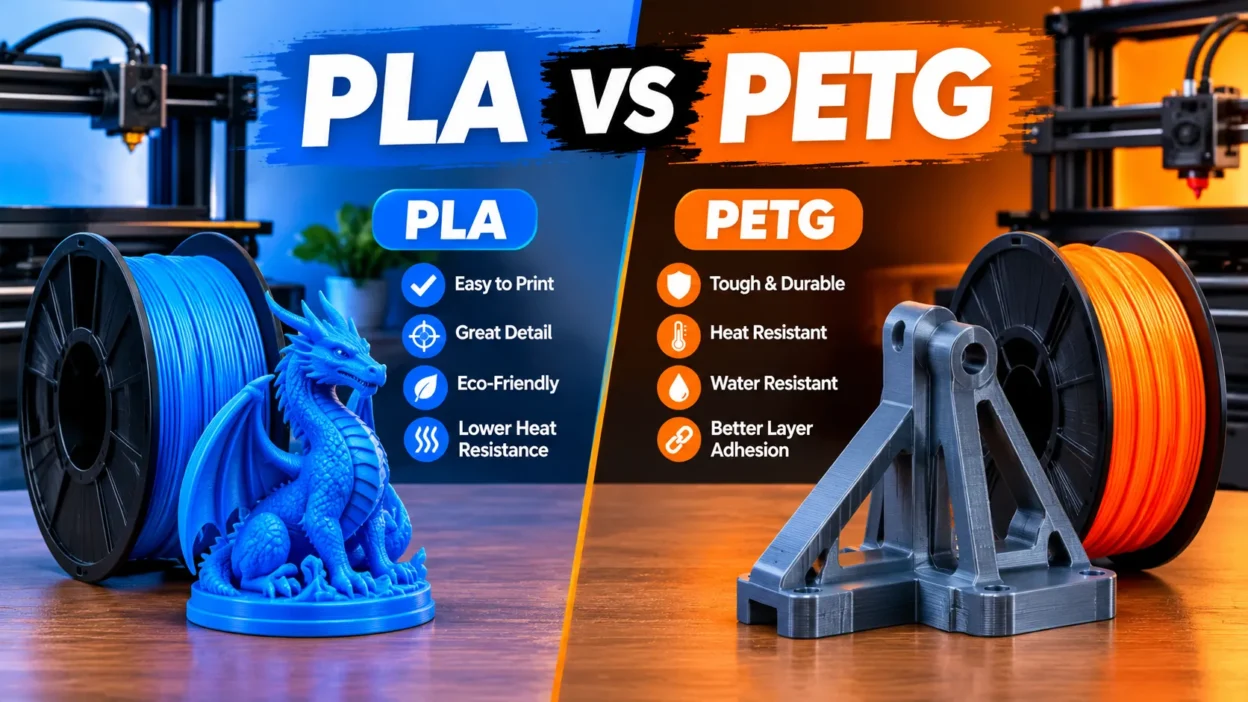
PLA is usually better for beginners, detailed models, prototypes, and easy indoor printing, while PETG is better for functional parts that need more toughness, flexibility, moisture resistance, or heat resistance.
Neither is universally stronger: PLA is typically stiffer, while PETG is generally tougher and less brittle.
Key Takeaways
- Choose PLA for easy printing, sharp details, models, prototypes, and indoor projects.
- Choose PETG for tougher functional parts, clips, brackets, and parts exposed to moderate heat or moisture.
- PETG generally handles impact and bending better, while PLA is stiffer.
- PETG usually requires higher printing temperatures and can produce more stringing.
- For permanent outdoor exposure, especially strong UV, ASA may be a better choice than either PLA or PETG.
What Is the Difference Between PLA and PETG?
PLA and PETG are two popular materials used in FDM 3D printing, but they behave differently once printed.
PLA, or polylactic acid, is known for being easy to print and producing detailed, clean-looking models. It is widely used for prototypes, figures, toys, decorations, and other indoor parts that do not face high heat or heavy mechanical stress.
PETG, or polyethylene terephthalate glycol-modified, is designed more toward toughness and practical use. It has good layer adhesion, better temperature resistance than standard PLA, and is commonly used for mechanical parts, holders, clamps, and some outdoor applications.
So the real PLA vs PETG question is not simply “Which one is better?” It is which material better fits the job.
PLA vs PETG: Quick Comparison
| Feature | PLA | PETG |
|---|---|---|
| Ease of printing | Excellent | Good |
| Beginner-friendly | Excellent | Good |
| Stiffness | Higher | Lower |
| Toughness | Lower | Higher |
| Impact resistance | Lower | Higher |
| Heat resistance | Lower | Higher |
| Fine detail | Excellent | Good |
| Stringing | Usually lower | Usually higher |
| Moisture resistance | Moderate | Good |
| Functional parts | Limited to suitable applications | Excellent |
| Outdoor use | Limited | Better |
| Typical nozzle range | About 185–235°C | About 215–270°C |
| Typical bed range | About 50–60°C | About 70–90°C |
These are broad ranges rather than universal settings. Your specific filament manufacturer and printer profile should take priority. Prusa, for example, lists PLA around 185–235°C and PETG around 215–270°C in its general material guide.
Which Is Stronger: PLA or PETG?
This question needs a more careful answer because strength can mean different things.
PLA can be very stiff and can perform well when a part needs to resist bending. But it tends to be more brittle. Under a sudden impact, a PLA part may crack or snap instead of bending.
PETG is generally tougher. It can flex more and absorb impacts before breaking, which is why it is commonly selected for clips, brackets, holders, and other functional parts. Prusa specifically recommends PETG for mechanically stressed parts and highlights its toughness and durability.
Stiffness vs Toughness
Think of the difference this way:
PLA: stiff and rigid, but more likely to snap.
PETG: less rigid, but more likely to bend or deform before breaking.
That means a rigid PLA bracket may feel stronger when you first hold it, while a PETG bracket may survive a drop or repeated flexing better.
The actual performance also depends on wall thickness, infill, print orientation, layer height, nozzle temperature, and the design of the part. A badly designed PETG print can still fail.
PLA vs PETG for Heat Resistance
PETG wins this category.
Standard PLA has relatively low heat resistance. Prusa describes PLA as unsuitable for applications requiring increased temperature resistance, while PETG is recommended for applications needing better temperature performance.
This difference matters in everyday situations.
For example, imagine printing a phone holder and leaving it inside a car during summer. PLA may soften or deform when exposed to sufficiently high temperatures. PETG gives you considerably more thermal margin.
That does not mean PETG is a high-temperature material. If a part must survive extreme or continuous heat, materials such as ASA, ABS, polycarbonate, or specialized high-temperature filaments may be more appropriate.
Which Is Easier to Print?
PLA is easier for most users.
It generally prints at lower temperatures, produces good detail, and is forgiving when you are learning your printer. Prusa describes PLA as one of the easiest materials to print and recommends it for detailed models, figures, and quick prototypes.
PETG is still considered relatively easy to print, but it has a few extra quirks.
It tends to produce more stringing and oozing. Its bridging and overhang performance can also be less convenient than PLA. PETG can adhere very strongly to certain build surfaces, so choosing the correct print sheet matters.
If you are printing your first few models, PLA will usually give you fewer headaches.
Print Quality and Appearance
PLA generally has the advantage when appearance and fine detail are the priority.
It cools quickly and works particularly well for small models, figures, miniatures, and prototypes with sharp features.
PETG can still produce attractive prints, but its tendency to string and ooze can make small decorative details less clean. It is often better suited to parts where function matters more than a perfect cosmetic finish.
For a detailed miniature sitting on a shelf, choose PLA.
For a bracket holding something in place, PETG may be the better choice.
PLA vs PETG for Outdoor and Functional Parts
PETG is usually the better choice for functional and semi-outdoor applications.
It is commonly used for holders, clamps, mechanical parts, enclosures, and other objects that may experience repeated handling. Its combination of toughness, layer adhesion, and temperature resistance makes it more practical than PLA for many of these jobs.
PLA is better suited to indoor applications where appearance and easy printing matter more.
For outdoor use, PETG is generally preferable to PLA, especially when moisture and moderate heat are involved. However, permanent exposure to strong sunlight is a different situation. For long-term UV exposure, ASA is often a better material to consider because it is specifically valued for outdoor durability.
When Should You Choose PLA?
Choose PLA when:
- You are new to 3D printing.
- You are printing models or miniatures.
- Fine detail matters.
- The part will stay indoors.
- The part will not experience high temperatures.
- You want a simple and reliable printing experience.
- You are making a prototype mainly for shape or appearance.
- You want a large range of colors and specialty finishes.
PLA is the sensible default for many hobby projects because you can get excellent results without complicated material tuning.
When Should You Choose PETG?
Choose PETG when:
- The part needs to survive impacts.
- The part will flex or be handled frequently.
- You are printing brackets, clips, holders, or enclosures.
- The part may experience moderate heat.
- Moisture resistance matters.
- You need stronger functional performance than a typical PLA print provides.
- The part will be used outdoors in suitable conditions.
PETG is especially useful when a part has to do a job, rather than simply look good.
Can You Use PLA and PETG on the Same 3D Printer?
Yes. Many modern FDM printers can print both materials.
However, you should not assume that one slicer profile works perfectly for both. PLA and PETG use different temperature ranges and cooling behavior. PETG also has different requirements for bed surfaces and can string more readily.
Always start with the filament manufacturer’s recommended settings and adjust from there.
A useful approach is to master PLA first, then learn PETG when you need its additional toughness or temperature resistance.
Frequently Asked Questions
Is PETG stronger than PLA?
It depends on what you mean by stronger. PLA is generally stiffer, while PETG is usually tougher and more impact-resistant. For parts that may bend, drop, or experience repeated stress, PETG is often the better practical choice. Material properties also vary by brand and print settings.
Which is better for beginners, PLA or PETG?
PLA is usually the better first filament. It prints at lower temperatures, handles detailed models well, and is generally more forgiving. PETG is also beginner-friendly, but stringing, stronger bed adhesion, and different cooling requirements can make it slightly more demanding.
Is PETG more heat resistant than PLA?
Yes. PETG generally provides more heat resistance than standard PLA. The exact temperature limit depends on the formulation and print conditions, so check the technical data for your particular filament rather than relying on a single universal temperature.
Can PLA be used outdoors?
PLA can be used for some short-term or mild outdoor applications, but it is not a strong choice for parts exposed to prolonged heat and sunlight. PETG is generally more suitable for moderate outdoor conditions, while ASA is worth considering for long-term, high-UV exposure.
Does PETG print slower than PLA?
Not necessarily. Printer capabilities and filament profiles determine actual speed. The bigger difference is that PETG often needs more careful tuning for temperature, cooling, retraction, and stringing. A well-tuned PETG profile can still print efficiently.
Final Verdict
There is no universal winner in the PLA vs PETG debate.
Choose PLA when you want easy printing, excellent detail, attractive models, and reliable indoor prototypes. Choose PETG when your part needs more toughness, flexibility, moisture resistance, or moderate heat resistance.
If you are buying your first spool, start with PLA. Once you begin making functional parts that need to survive real-world use, PETG is the natural next material to learn.
For extreme heat or permanent outdoor UV exposure, however, look beyond both materials and consider an engineering filament better suited to the environment.

I am George R. R. Martin, an American author best known for A Song of Ice and Fire and its world of unforgettable characters.
I share my writing journey and literary insights with readers on Elitenamez.com.