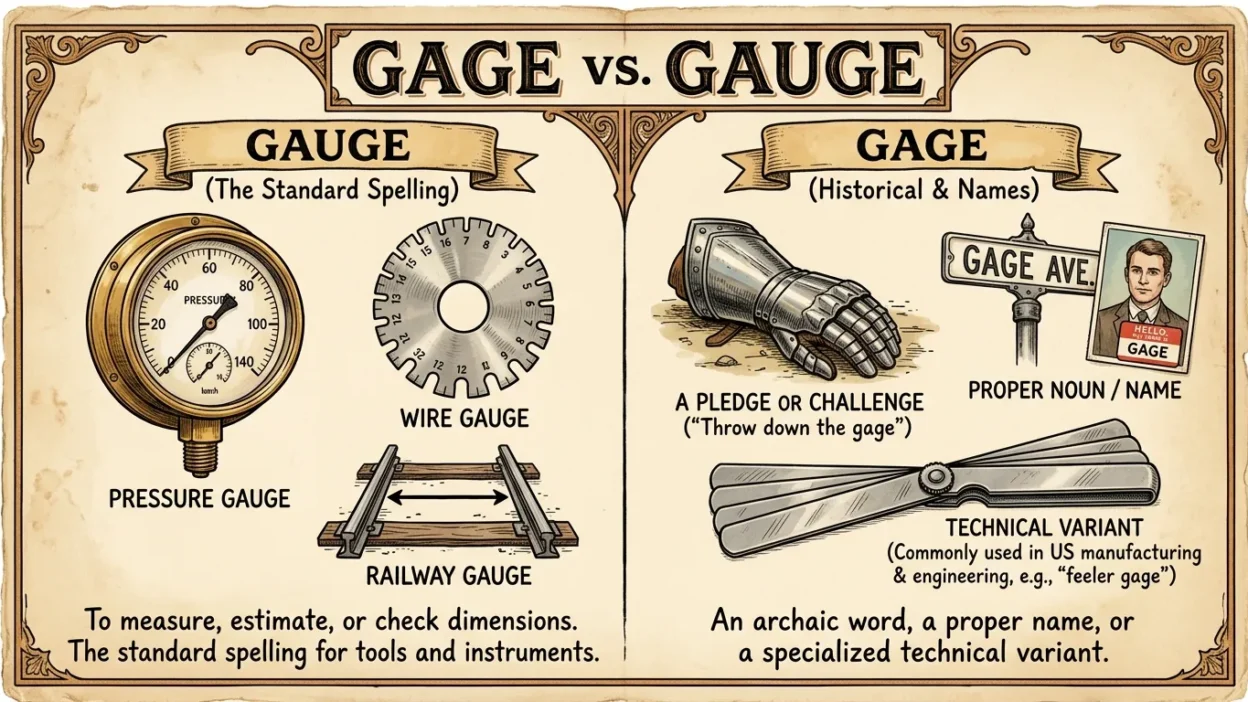
Gauge is the standard spelling in modern American English when referring to a measuring instrument, a measurement standard, or the act of estimating something.
Gage is also a real English word and can appear as a less common spelling in specialized contexts. It also has historical meanings related to a pledge or a challenge. For most everyday writing, choose gauge.
Key Takeaways
- Gauge is the preferred spelling for most modern uses involving measurement, estimation, or judgment.
- Gage is a legitimate word, not always a spelling mistake.
- Write pressure gauge, fuel gauge, and gauge interest in ordinary American English.
- Some technical documents use gage according to established terminology or industry conventions.
- Both words are pronounced the same in their common measurement-related uses: “gayj,” rhyming with “page.”
What Is the Difference Between Gage and Gauge?
The main difference between gage and gauge is their usage and frequency. Both spellings exist, but gauge is much more common in modern English.
You will usually see gauge when someone talks about measuring pressure, checking the thickness of a material, or estimating another person’s reaction. The word can function as both a noun and a verb.
For example:
- Noun: The mechanic checked the tire pressure with a gauge.
- Verb: We need to gauge customer interest before launching the product.
The spelling gage has a narrower role. It can serve as a variant of gauge in some technical contexts, but it also has an older meaning associated with something offered as a pledge or a token of challenge.
Dictionary references recognize these uses, although gauge remains the more familiar spelling for most readers.
What Does Gauge Mean?
Gauge is a noun or verb connected to measurement, standards, and estimation.
As a noun, it can describe an instrument that measures a quantity or a standard used to express size or thickness.
Examples include:
- A pressure gauge measures pressure.
- A fuel gauge indicates how much fuel remains in a vehicle.
- A wire gauge describes wire size.
- A temperature gauge displays a temperature reading.
As a verb, gauge means to measure, estimate, assess, or judge something.
For example:
- The teacher asked questions to gauge the students’ understanding.
- We used a ruler to gauge the length of the table.
- She watched his expression to gauge his reaction.
In each example, the word describes measuring something directly or forming an estimate based on available information.
What Does Gage Mean?
Gage has two important uses.
First, it can be a less common spelling of gauge, especially in certain technical or specialized contexts. You may encounter it in established terminology, product specifications, or older technical documents.
Second, gage has a historical meaning connected to a pledge, security, or token of challenge. In medieval traditions, for example, a glove thrown down could serve as a challenge to combat.
This older meaning is different from the everyday use of gauge as a measuring instrument.
Example: In a historical story, a knight might throw down a gage to challenge an opponent.
You are unlikely to use this meaning in an ordinary email, school assignment, or business article. For modern writing about measurement or estimation, gauge is generally the better choice.
Gage vs Gauge Comparison Table
The following table summarizes the differences.
| Feature | Gage | Gauge |
|---|---|---|
| Standard everyday spelling | Less common | Preferred |
| Measuring instrument | Used in some variants and technical terms | Standard spelling |
| Verb meaning to estimate | Less common variant | Preferred |
| Historical meaning | Pledge or token of challenge | Not the usual meaning |
| Technical documents | Sometimes used | Widely used |
| Pronunciation | Usually “gayj” | “Gayj” |
| Best choice for general writing | Usually not | Yes |
The key point is that these words are not always interchangeable in every context. Although gage can be a valid variant, gauge is the spelling most readers expect when discussing measurements or estimating something.
When Should You Use Gauge?
Use gauge in most everyday, academic, professional, and general technical writing when you mean to measure or assess something.
Here are the most common situations.
When Measuring Something
Use gauge when referring to a device or standard that measures a physical quantity.
Examples include:
- Pressure gauge: A device used to check pressure in a system.
- Fuel gauge: An instrument that shows the fuel level in a vehicle.
- Tire pressure gauge: A tool used to check tire pressure.
- Wire gauge: A measurement designation for wire size.
- Shotgun gauge: A designation used to identify the bore size of a shotgun.
Example sentences:
- The pressure gauge showed that the system needed attention.
- My car’s fuel gauge indicated that the tank was almost empty.
- He used a tire gauge before starting the road trip.
- The technician checked the wire gauge before selecting the correct cable.
In these examples, gauge is the familiar spelling and communicates the intended meaning clearly.
When Estimating or Judging Something
You should also use gauge when describing an attempt to understand, evaluate, or estimate a situation.
This meaning is common in conversations, business writing, education, and news reporting.
Examples:
- We conducted a survey to gauge customer satisfaction.
- It was difficult to gauge her reaction to the announcement.
- The company wants to gauge demand before expanding.
- The coach watched the players to gauge their confidence.
Notice that none of these examples requires a physical measuring instrument. The verb describes making a judgment or estimate.
A useful rule is to choose gauge whenever you mean to assess a person’s response, measure interest, estimate demand, or understand a situation.
When Is Gage Correct?
Although gauge is the usual choice, there are situations in which gage is appropriate.
Historical and Traditional Meanings
In historical writing, gage may refer to a pledge, something deposited as security, or a token representing a challenge.
For example:
“The knight accepted the gage and prepared for the contest.”
Here, gage does not mean a measuring device. It refers to the historical idea of a challenge or pledge.
Writers discussing medieval customs, older literature, or historical legal practices may need this word.
Specialized Technical Usage
Some industries and technical references preserve gage in established terms. In American manufacturing and precision measurement, for example, you may encounter terms such as plug gage, ring gage, or snap gage.
These terms can be correct within the terminology used by a particular manufacturer, specification, or technical standard. They should not automatically be changed simply because gauge is more common in general English
If you are editing a technical document, check the relevant specification or the manufacturer’s official terminology.
For ordinary writing, however, there is no need to replace the familiar spelling gauge with gage.
Gage vs Gauge Examples in Sentences
The following examples show how to choose the spelling based on meaning and context.
| Sentence | Correct choice | Explanation |
|---|---|---|
| I checked the tire ___ before driving. | Gauge | Refers to a measuring tool. |
| We need to ___ public interest. | Gauge | Means to assess interest. |
| The car’s fuel ___ is broken. | Gauge | Refers to a dashboard instrument. |
| She tried to ___ his reaction. | Gauge | Means to estimate or judge. |
| The historical text describes a knight’s ___ of battle. | Gage | Refers to an old token of challenge. |
| The technician followed the specification for a ring ___. | Gage or gauge, depending on the specification | Follow the established technical term. |
Here are a few more examples of the preferred spelling in everyday American English:
- Correct: The survey helped us gauge customer interest.
- Less common variant: The survey helped us gage customer interest.
- Correct: The mechanic replaced the faulty pressure gauge.
- Correct in a specific technical context: The machinist selected a plug gage according to the applicable specification.
The second example illustrates an important distinction: gage is attested as a variant, but gauge is the safer choice when writing for a general audience.
Is It Gauging or Gaging?
Both gauging and gaging exist, but they are not equally common.
Gauging is the preferred form in general writing. It means measuring, estimating, or judging something.
Examples:
- We are gauging interest in the new service.
- She is gauging the team’s progress.
- The engineer is gauging the pressure in the system.
Gaging is an accepted variant associated with the less common spelling gage. You may encounter it in specialized terminology or documents that follow a particular technical convention.
For most school assignments, blog posts, reports, and business communications, use gauging.
The same practical principle applies to related forms: prefer the standard spelling unless a recognized technical term or established house style calls for the alternative.
Common Mistakes to Avoid
When deciding between gage and gauge, watch out for these common errors.
1. Using gage in ordinary sentences about measurement
Instead of writing “We used a gage to check the tire pressure,” write “We used a gauge to check the tire pressure,” unless a specific technical convention requires gage.
2. Writing “gage interest” in general business copy
The familiar expression is “gauge interest.” It means estimating how interested people are in an idea, product, or service.
3. Assuming gage is never correct
This is another mistake. Gage is a real word with historical meanings and specialized uses. Context matters.
4. Changing technical terms without checking the source
If a manufacturer’s documentation specifies ring gage, preserve that term when accuracy and consistency require it.
5. Confusing pronunciation with spelling
The two forms are pronounced alike in their common measurement-related uses. Because they sound the same, you must rely on meaning and context to select the spelling.
Frequently Asked Questions
Is gage or gauge correct?
Both spellings exist, but gauge is the preferred spelling for most modern American English uses involving measurement or estimation. Gage is a legitimate variant in some specialized contexts and also has historical meanings. Unless you are following a specific technical convention, choose gauge.
Is gage a real word?
Yes. Gage is a real English word. It can be used as a less common variant of gauge and can refer historically to a pledge or a token of challenge. Its existence does not mean it is the best choice in every sentence.
Is it gauge interest or gage interest?
Gauge interest is the standard expression in general English. It means to estimate or assess how interested people are in something. For example, “The company launched a survey to gauge interest in its new product.” This spelling is appropriate for business writing, marketing content, and everyday communication.
Why is gauge spelled with a U?
The spelling reflects the word’s historical development and borrowing into English. Its spelling is not fully predictable from its pronunciation, which is why writers sometimes find it confusing. The simplest solution is to remember common expressions such as pressure gauge, fuel gauge, and gauge a reaction.
Is gage acceptable in technical writing?
Yes, in some contexts. Certain established technical terms use gage, particularly in precision measurement and manufacturing. However, terminology varies by specification and industry. Check the relevant standard or manufacturer’s documentation rather than assuming that either spelling is universally correct in every technical context.
What is the difference between gauging and gaging?
Gauging is the usual spelling when referring to measuring or estimating something. Gaging is a recognized but less common variant. In everyday writing, use gauging unless an established technical convention or style guide requires gaging.
Conclusion:
When comparing gage vs gauge, the simplest rule is to use gauge for most everyday writing. It is the standard spelling for measuring instruments, measurement standards, and the act of estimating or judging something.
Use gage when it has a specific historical meaning or when an established technical term calls for that spelling. It is not automatically wrong, but it is less common in general English.
Remember these familiar examples: pressure gauge, fuel gauge, wire gauge, and gauge interest. Following this rule will help you write clearly and choose the spelling your readers expect.

I am C.S. Lewis, a British writer, scholar, and Christian thinker best known for The Chronicles of Narnia and his influential works on Christian faith.
My writing continues to inspire readers around the world through timeless stories, faith, and thoughtful ideas.
For more author information and inspiring names, visit Elitenamez.com.