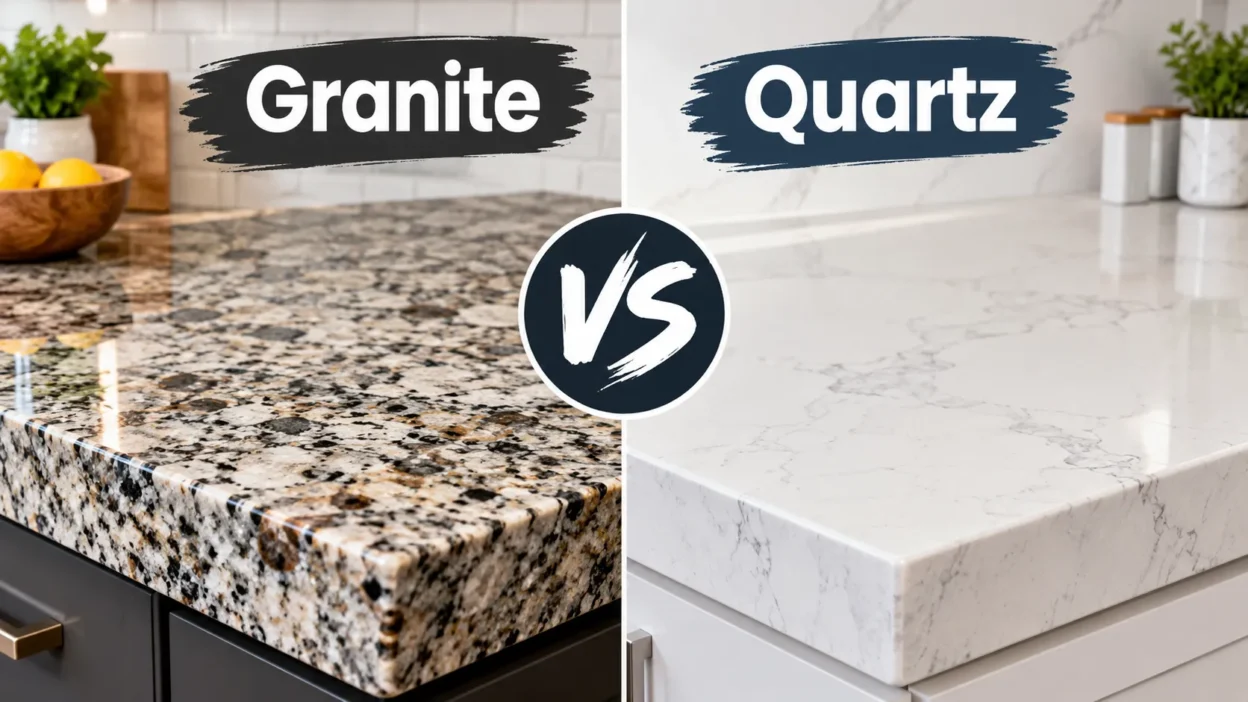
Granite and quartz are both durable countertop options, but they differ in important ways.
Granite is natural stone with unique patterns and strong heat resistance, while quartz is an engineered, nonporous surface that is easier to maintain.
The right choice depends on your budget, cooking habits, design preferences, and willingness to perform periodic maintenance.
Key Takeaways
- Granite is natural stone, so every slab has its own color, movement, and pattern.
- Quartz is engineered from quartz minerals, resin, pigments, and other materials for a more consistent appearance.
- Quartz generally requires no sealing, while some granite benefits from periodic sealing.
- Granite generally handles direct heat better, but hot cookware should still be handled carefully.
- Installed prices overlap, so the specific slab, fabrication, installation, and location can matter more than the material name alone.
What Is the Difference Between Granite and Quartz?
The biggest difference is how these countertop materials are made.
Granite is natural stone quarried from the earth and cut into slabs. Its appearance comes from the minerals naturally present in the rock. That means two slabs can have noticeably different colors, veins, or patterns.
Quartz countertops are engineered surfaces. They use natural quartz minerals combined with resins, pigments, and other materials. This manufacturing process allows manufacturers to create more predictable colors and patterns.
That difference affects more than appearance. It also influences maintenance, stain resistance, heat performance, and where each material makes sense.
Granite: Natural Stone
Granite is known for its hardness, durability, and natural appearance. The Natural Stone Institute notes that granite is widely used for kitchen countertops and heavily used surfaces because of its durability and longevity.
Granite is also naturally somewhat porous, although the amount of absorption varies among stones. Some granite countertops benefit from an impregnating sealer that increases stain resistance. The Natural Stone Institute specifically notes that not every granite countertop automatically needs sealing.
Quartz: Engineered Surface
Quartz countertops are designed to provide a consistent, low-maintenance surface. Because quality quartz surfaces are nonporous, they generally do not require sealing.
Quartz manufacturers also recommend simple daily cleaning with warm water and mild soap. However, nonporous does not mean indestructible. Quartz can still be damaged by excessive heat, sharp objects, harsh chemicals, or heavy impact.
Granite vs Quartz: Side-by-Side Comparison
| Feature | Granite | Quartz |
| Material | Natural stone | Engineered stone surface |
| Appearance | Unique natural variation | More consistent and controlled |
| Maintenance | Low, but some slabs benefit from sealing | Very low |
| Sealing | May be recommended depending on stone | Generally not required |
| Stain resistance | Good when properly cared for | Excellent due to nonporous surface |
| Heat resistance | Generally higher | Needs protection from hot cookware |
| Scratch resistance | High | High |
| Design consistency | Every slab can differ | More predictable |
| Outdoor use | Commonly suitable, depending on conditions | Product-specific; UV exposure matters |
| Cleaning | Mild stone-safe products | Warm water and mild soap are commonly suitable |
Neither surface should be treated as completely damage-proof. Even durable stone can chip at vulnerable edges, and quartz manufacturers recommend cutting boards and trivets as basic protection.
Cost: Granite vs Quartz
Cost is one of the most common reasons homeowners compare these materials, but there is no universal price winner.
Current U.S. comparison sources show substantial overlap between installed granite and quartz pricing. One 2026 comparison places granite around 40–100 per square foot installed and quartz around 50–120, while other current estimates show both materials extending considerably higher for premium slabs.
Your final price can depend on:
- Countertop size
- Slab thickness
- Material grade
- Edge profile
- Number of seams
- Sink and cooktop cutouts
- Backsplash requirements
- Installation complexity
- Local labor rates
- Brand or stone supplier
For that reason, comparing actual quotes for the slabs you like is more useful than relying on a simple “granite is cheaper” or “quartz is more expensive” rule.
Durability and Scratch Resistance
Both materials are designed for demanding everyday use.
Granite has excellent hardness and scratch resistance. The Natural Stone Institute describes granite as one of the harder dimension stones and notes its strong resistance to scratching from ordinary kitchen utensils.
Quartz is also highly durable and resistant to everyday wear. However, manufacturers do not describe it as scratch-proof or chip-proof. Heavy objects striking an edge, especially around sinks, can cause damage.
The practical rule is simple: use a cutting board with either countertop and avoid deliberately testing the surface with sharp or heavy objects.
Heat Resistance: Which Handles Hot Pans Better?
This is one area where the distinction between granite and quartz matters.
Granite generally has strong heat resistance. The Natural Stone Institute gives typical granite heat resistance around 250°C (about 480°F), while also warning that concentrated or localized heat can create thermal stress and cracking.
Quartz requires more caution because its resin component can be affected by intense or prolonged heat. Quartz manufacturers recommend using trivets or hot pads rather than putting hot cookware directly on the countertop.
So if you regularly move cookware directly from the oven or stovetop to the counter, granite’s heat tolerance may better match that habit. Even with granite, however, using a trivet is sensible.
Stain Resistance and Maintenance
Quartz has a major practical advantage here: its nonporous surface does not readily absorb liquids. That makes routine cleaning simple and eliminates the need for routine sealing on many quartz products.
Granite can also perform very well against stains, especially when the particular stone is naturally resistant and properly maintained. But granite is not one uniform material. Its absorption and care requirements vary by slab.
The Natural Stone Institute recommends understanding the specific stone before choosing cleaning products or deciding whether sealing is appropriate.
For either material, clean spills rather than allowing food, drinks, or chemicals to sit for long periods.
Appearance and Design Options
This is largely a matter of personal taste.
Granite offers the appeal of genuine natural variation. Each slab can have its own mineral patterns, speckles, veins, and color movement. If you want a countertop that feels completely unique, that natural variation can be important.
Quartz provides more predictable patterns. Manufacturers can produce colors ranging from subtle neutrals to designs inspired by marble and other natural stones.
This makes quartz useful when you want the countertop to coordinate closely with cabinets, flooring, backsplash tile, or a kitchen island.
There is also an important practical tip: look at the actual slab whenever possible. A small sample may not show the full pattern, movement, or color variation that appears across a large countertop.
Granite vs Quartz for Different Kitchens
Choose Based on Cooking Habits
Think about how you actually use your kitchen.
If your priority is easy daily care and you prefer not to think about sealing, quartz can fit that lifestyle well.
If you do a lot of high-heat cooking and value natural stone, granite may fit your priorities more closely.
Neither choice eliminates basic countertop care. Cutting boards, trivets, prompt spill cleanup, and sensible cleaning products remain useful.
Consider Outdoor Use
Outdoor applications require additional attention because sunlight, temperature changes, and weather can affect countertop materials.
Granite is commonly used outdoors, but the exact stone and installation environment still matter.
Standard indoor quartz should not automatically be assumed suitable for an outdoor kitchen. Some manufacturers make specialized outdoor quartz products, while other quartz products have limitations related to prolonged UV exposure. Always check the specific product’s outdoor rating and warranty before installation.
Think About Long-Term Maintenance
Quartz is attractive to homeowners who want a countertop that requires very little routine maintenance.
Granite can also be relatively easy to maintain, but its care depends on the individual stone and whether a sealer is recommended.
That means maintenance should be discussed with the fabricator or supplier before you buy rather than assuming every granite slab follows the same schedule.
Pros and Cons of Granite and Quartz
Granite Pros
- Natural stone appearance
- Unique slab-to-slab variation
- Strong heat resistance
- High durability
- Good scratch resistance
- Suitable for many indoor and outdoor applications
Granite Cons
- Some stones benefit from periodic sealing
- Natural patterns can be difficult to match
- Porosity varies by stone
- Heavy impact can chip edges
- Premium or exotc slabs can become expensive
Quartz Pros
- Nonporous surface
- Generally does not require sealing
- Easy everyday cleaning
- Consistent colors and patterns
- Strong resistance to everyday stains
- Wide range of modern designs
Quartz Cons
- Direct high heat can damage the surface
- Edges can chip from heavy impacts
- Some designs can look more manufactured
- Outdoor suitability depends on the specific product
- Premium designs can be expensive
Which One Fits Your Home?
Instead of asking whether granite or quartz is universally better, start with the features that matter most in your home.
If low maintenance, stain resistance, and consistent design are your main concerns, quartz may align with those priorities.
If natural variation, strong heat tolerance, and genuine stone character matter more, granite may be a better match for your preferences.
Budget should be based on actual installed quotes rather than material labels alone. Two countertops made from different slabs can have surprisingly similar prices after fabrication and installation are included.
The smartest comparison is therefore not simply granite vs quartz. It is this specific granite slab vs this specific quartz slab, installed by the fabricator you plan to use.
FAQs:
Is quartz better than granite?
Neither material is automatically better for every home. Quartz offers a nonporous, low-maintenance surface and predictable designs, while granite offers natural variation and stronger tolerance for direct heat. Your cooking habits, maintenance preferences, design goals, and installation environment should guide the choice.
Is granite cheaper than quartz?
Granite can be less expensive at some price levels, but current U.S. installed prices overlap significantly. Slab quality, thickness, fabrication, edge work, cutouts, labor, and location can all change the final cost. Get quotes for the exact materials you are considering.
Which lasts longer, granite or quartz?
Both can provide many years of service when properly installed and cared for. Longevity depends not only on the material but also on installation quality, everyday use, impact, heat exposure, and maintenance.
Does quartz need to be sealed?
Most quartz countertop surfaces do not require sealing because they are manufactured to be nonporous. Major quartz manufacturers state that their surfaces do not need routine sealing.
Can you put a hot pan on quartz?
It is best not to place hot pans directly on quartz. Manufacturers recommend using a trivet or hot pad because intense or sudden heat can discolor, crack, or otherwise damage the surface.
Conclusion:
Granite and quartz are both strong countertop choices, but they solve different priorities. Granite brings natural variation and strong heat performance, while quartz focuses on consistent design, nonporous construction, and easy maintenance.
Compare the actual slabs, installation quotes, care requirements, and warranty terms before making the final decision.
The best countertop for your home is the one whose characteristics match how you cook, clean, and use the space every day.

I am Maya Angelou, a celebrated American author, poet, and civil rights activist known for my powerful writing and inspiring life story.
My work continues to influence readers around the world through its themes of courage, identity, and resilience. Learn more about my life and work at Elitenamez.com.