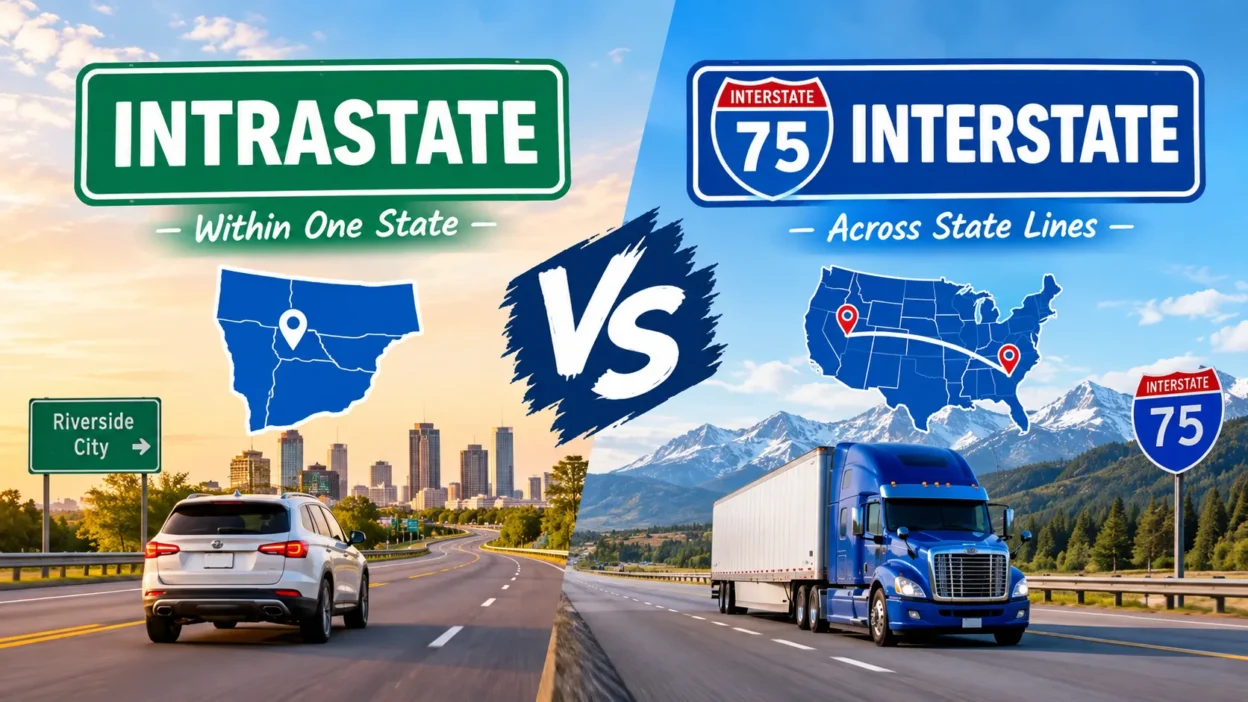
Intrastate means something takes place within a single state, while interstate generally means it involves two or more states. In U.S.
transportation and commerce, the distinction can be more specific: a movement may qualify as interstate commerce even when a vehicle stays inside one state if the shipment is part of an interstate journey.
Key Takeaways
- Intrastate generally means activity occurring within one state.
- Interstate generally involves more than one state.
- In trucking, crossing a state line is not the only factor used to determine interstate commerce.
- Intrastate operations are primarily subject to applicable state requirements, while interstate operations can bring federal requirements into play.
- CDL, insurance, registration, and operating-authority requirements depend on the specific operation and applicable laws.
What Does Intrastate Mean?
Intrastate means something that happens within a single state.
The word is easy to break down. “Intra-” means within, so intrastate literally describes activity occurring inside one state.
For example, if a trucking company picks up a shipment in Dallas and delivers it to Houston without the shipment being part of an interstate movement, that is generally an intrastate operation.
The same basic idea applies beyond trucking. An intrastate business transaction, transportation service, or other activity can take place entirely within one state’s boundaries.
However, the legal meaning can depend on the subject. In federal motor-carrier regulations, intrastate commerce is defined as trade, traffic, or transportation that does not meet the regulatory definition of interstate commerce.
Examples of Intrastate Activity
Consider these simple examples:
- A delivery company transports goods from one city to another within the same state.
- A passenger service carries customers between two locations within one state.
- A local business sells and delivers products without the transaction becoming part of interstate commerce.
- A truck carries a load entirely within a state that is not part of an interstate shipment.
The important point is that “within one state” is the starting idea, but specialized laws may apply additional tests.
What Does Interstate Mean?
Interstate generally means between or involving two or more states.
For example, a truck traveling from Pennsylvania to Ohio is engaged in an interstate movement because the transportation crosses a state boundary.
The term is also used in everyday language. An interstate highway connects or serves multiple states, while interstate commerce involves commercial activity among states.
In federal transportation regulations, however, interstate commerce has a broader definition. It can include transportation between a location in one state and a location outside that state, movement through another state, or an in-state movement that is part of trade or transportation originating or ending outside the state.
That broader definition is one of the biggest reasons people become confused about intrastate vs interstate.
Intrastate vs Interstate: Main Differences
| Factor | Intrastate | Interstate |
| Basic meaning | Within one state | Between or involving states |
| Typical transportation | Stays within one state | Crosses state lines or is part of an interstate movement |
| Main regulatory level | State requirements generally apply | Federal requirements may apply |
| Common trucking context | In-state operation | Interstate commerce |
| CDL considerations | State rules may apply | Federal requirements may apply |
| Examples | Houston to Dallas | Texas to Oklahoma |
The table gives the basic distinction, but transportation law has important exceptions and details.
For example, FMCSA explains that transportation can be interstate even when the truck’s physical route stays within one state.
Is a Trip Within One State Always Intrastate?
No.
This is probably the most important detail to understand.
Suppose a truck picks up cargo in Dallas and delivers it to Houston. At first glance, that looks intrastate because both cities are in Texas.
But imagine that the cargo originally came from Oklahoma and the Texas portion is simply one part of a continuing shipment. Under the federal definition, the movement may qualify as interstate commerce, even though the truck itself does not cross the Texas-Oklahoma border on that particular leg.
Similarly, FMCSA states that transportation between two locations within one state can be interstate if the route passes through another state or if the cargo or passengers are part of a movement that originated or will terminate outside the state.
So, when determining the classification of a commercial movement, ask more than:
“Did the truck cross a state line?”
Also consider:
- Where did the shipment originate?
- Where is it ultimately going?
- Is the movement part of a larger interstate shipment?
- Does the route pass through another state?
- What type of transportation is involved?
Intrastate vs Interstate Trucking
The distinction is especially important in commercial trucking.
Intrastate Trucking
Intrastate trucking generally involves transportation that remains within one state and does not qualify as interstate commerce.
A local carrier might haul construction materials between several cities in the same state. If the movement is genuinely intrastate, the carrier must follow the applicable state requirements.
Those requirements are not identical across the country. A rule that applies to an intrastate carrier in Texas may not be the same as one in California or Florida.
Interstate Trucking
Interstate trucking involves transportation across state lines or transportation that meets the federal definition of interstate commerce.
FMCSA specifically includes transportation between states, transportation through another state, and certain in-state portions of shipments that originate or terminate outside the state.
Interstate operations can therefore bring federal requirements involving areas such as driver qualifications, vehicle safety, registration, and other compliance matters.
This is why a carrier should not classify an operation solely by looking at the truck’s daily route.
Intrastate vs Interstate CDL
The terms also appear when drivers self-certify their type of commercial operation.
FMCSA explains that interstate commerce includes operating a commercial motor vehicle from one state to another or between two locations in one state when the trip involves another state or an interstate shipment. Intrastate commerce applies when the operation stays within a state and does not meet those interstate conditions.
For CDL holders, this classification can affect which federal requirements apply.
For example, FMCSA says interstate commercial drivers operating qualifying vehicles are subject to federal medical-certification requirements. CDL holders also self-certify their applicable operating category with their state driver licensing agency.
State rules can be different for intrastate drivers, so drivers should check the requirements of the state where they operate rather than assuming that every CDL rule is identical nationwide.
Why the Difference Matters
Understanding intrastate vs interstate matters because the classification can affect the rules that apply to a business or driver.
For a trucking company, the distinction may influence:
- Registration requirements
- Operating authority
- Driver qualification requirements
- Medical certification
- Hours-of-service requirements
- Insurance requirements
- Recordkeeping
- State or federal regulatory oversight
FMCSA’s own guidance emphasizes that determining interstate versus intrastate status is important for commercial motor vehicle operations.
It is also worth remembering that intrastate does not mean “unregulated.” An intrastate carrier still has to comply with applicable state and, in some situations, federal requirements.
Likewise, simply owning a truck or having a CDL does not by itself determine whether a particular movement is interstate.
Common Mistakes About Intrastate and Interstate
Mistake 1: Assuming interstate always means crossing a state line
Crossing a state line is a common example of interstate transportation, but it is not the complete federal test for interstate commerce.
A shipment can qualify as interstate even when a particular truck movement stays within one state.
Mistake 2: Thinking intrastate means no federal rules apply
Intrastate operations are primarily subject to state requirements, but certain federal requirements can still apply depending on the activity.
Mistake 3: Confusing short-haul with intrastate
These terms describe different things.
Intrastate/interstate concerns the nature and jurisdiction of the commerce or movement. Short-haul/long-haul describes the operating distance or type of route.
A short trip can be interstate, and a long trip can occur entirely within one state.
Mistake 4: Assuming every state has identical intrastate rules
State requirements can vary. A carrier operating only within one state should check that state’s transportation agency for the rules that apply to its specific operation.
Frequently Asked Questions
Is interstate the same as crossing state lines?
Not always. Crossing a state line is a straightforward example of interstate transportation, but federal transportation rules can also treat an in-state movement as interstate when it is part of a shipment originating or terminating outside the state or otherwise meets the federal definition.
Can trucking within one state be interstate?
Yes. A truck can remain physically inside one state while transporting cargo that is part of an interstate movement. FMCSA specifically recognizes this situation in its guidance on interstate commerce.
What is intrastate commerce?
Intrastate commerce generally refers to trade, traffic, or transportation within a state that does not qualify as interstate commerce under the applicable legal definition. In FMCSA regulations, intrastate commerce is defined by excluding activity that meets the federal definition of interstate commerce.
What is interstate commerce?
Interstate commerce refers to trade, traffic, or transportation involving different states or certain movements connected to commerce outside the state. Under FMCSA rules, the definition can include some transportation that physically occurs entirely within one state.
Conclusion:
The simplest way to remember intrastate vs interstate is this: intrastate means within one state, while interstate means involving more than one state.
For ordinary conversation, that distinction is usually enough. In trucking and commercial transportation, however, the legal definition is more detailed. An in-state trip can still be interstate commerce when it is part of a larger interstate movement.
If the classification affects your CDL, operating authority, insurance, or compliance obligations, use the applicable federal and state rules for your exact operation rather than relying only on where the truck travels.

I am George R. R. Martin, an American author best known for A Song of Ice and Fire and its world of unforgettable characters.
I share my writing journey and literary insights with readers on Elitenamez.com.