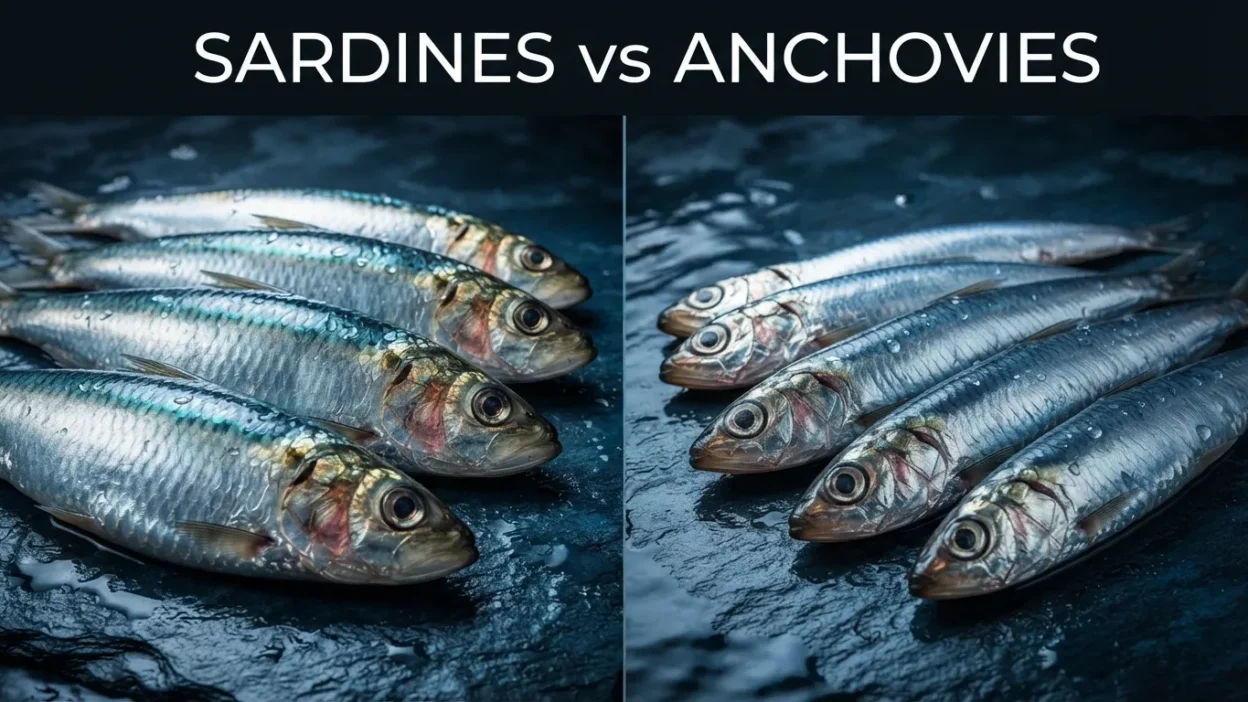
Sardines and anchovies are different types of small, oily fish. Sardines are usually larger, milder, meatier, and commonly canned whole.
Anchovies are smaller and are often salt-cured, giving them a much stronger, saltier, umami-rich flavor.
Both provide protein and omega-3 fats, but they serve very different roles in cooking.
Key Takeaways
- Sardines and anchovies are not the same fish and belong to different fish families.
- Sardines are usually milder, meatier, and better suited to eating as a main protein.
- Anchovies are commonly salt-cured and work more like a flavoring ingredient.
- Both provide protein and omega-3 fats and are considered low-mercury choices by the FDA.
- The biggest nutritional concern with many anchovy products is their high sodium content.
Are Sardines and Anchovies the Same Fish?
No. Sardines and anchovies may look similar because both are small, oily, silver-colored fish, but they belong to different families.
Sardines are members of the Clupeidae family, which includes several small herring-like fish. Anchovies belong to the Engraulidae family. So although they are related as small schooling fish, one is not simply a smaller version of the other.
There is also a major difference in how they are normally sold.
Sardines are commonly cooked and canned whole, often packed in olive oil, water, or sauce. Their soft bones can usually be eaten because the canning process makes them tender.
Anchovies sold in American grocery stores are more often filleted, salt-cured, and packed in oil. That curing process creates the intense salty and savory flavor many people associate with anchovies.
Sardines
Sardines are generally the larger and chunkier of the two. They have a firm, flaky texture and a rich but relatively mild flavor.
Because they are usually sold as a whole portion, sardines can be eaten directly from the can, placed on toast or crackers, added to salads, or used in pasta and rice dishes.
Anchovies
Anchovies are generally smaller and more slender. Their familiar canned or jarred form is usually cured in salt before being packed in oil.
Instead of serving as the main protein, anchovies are often used in small amounts to add depth to sauces, dressings, pizzas, pastas, and other dishes.
Sardines vs Anchovies: Key Differences
| Feature | Sardines | Anchovies |
|---|---|---|
| Fish family | Clupeidae | Engraulidae |
| Typical size | Larger | Smaller |
| Flavor | Mild, rich, briny | Strong, salty, savory |
| Texture | Firm and flaky | Soft after curing |
| Common preservation | Canned, cooked | Salt-cured and packed in oil |
| Typical use | Main protein | Flavor enhancer |
| Protein | High | High |
| Omega-3 fats | High | High |
| Sodium | Often moderate, depending on product | Often very high in cured products |
| Mercury | Very low | Very low |
The most important point is that processing changes the eating experience. A fresh anchovy is not necessarily as intensely salty as the cured anchovies commonly sold in jars. Likewise, different sardine products can vary in flavor depending on the species, oil, sauce, and preparation.
Sardines vs Anchovies: Taste and Texture
Taste is where the difference becomes especially obvious.
What Sardines Taste Like
Sardines have a rich, oily seafood flavor, but they are usually less intense and less salty than cured anchovies. Their texture is meaty and flaky.
If you enjoy tuna or other oily fish, sardines may be easier to try because they can be eaten as a substantial part of a meal rather than used only as a seasoning.
Their flavor also works well with simple ingredients such as lemon, olive oil, garlic, herbs, tomatoes, and chili.
What Anchovies Taste Like
Cured anchovies are famous for their strong salty, savory, umami flavor.
That intensity is one reason chefs use them in small amounts. An anchovy fillet can melt into a warm sauce or dressing and add depth without necessarily making the finished dish taste strongly like fish.
Anchovies are especially common in Caesar dressing, pasta sauces, pizza toppings, and Mediterranean-style dishes.
So if you’re asking, “Which tastes stronger, sardines or anchovies?”, cured anchovies usually win by a wide margin.
Sardines vs Anchovies Nutrition
Both fish are nutrient-dense choices. They provide high-quality protein and healthy fats, including the omega-3 fatty acids EPA and DHA.
Nutrition can vary considerably depending on whether the fish is fresh, canned in water, packed in oil, or cured with salt. That means there is no single nutrition number that applies to every can.
Still, some broad differences are useful.
Which Has More Protein?
Both provide substantial protein. Some nutrition comparisons show anchovies with slightly more protein per 100 grams, while sardines can provide a similarly strong amount. The difference is not usually the most important reason to choose one over the other.
If your goal is simply to add more protein to your diet, either can work.
What About Omega-3s, Calcium, and Vitamins?
Both sardines and anchovies contain omega-3 fats, which are one reason seafood is included in healthy eating patterns.
Sardines have a notable advantage in one practical area: canned sardines are often eaten with their soft bones. Those edible bones can contribute a meaningful amount of calcium.
Sardines are also commonly recognized as a useful source of vitamin B12 and vitamin D, while anchovies can provide nutrients such as iron, selenium, and niacin. Exact amounts depend on the product and serving size.
The USDA’s MyPlate guidance also includes canned anchovies and sardines among foods that count toward the Protein Foods Group.
Why Sodium Matters
Sodium is one of the biggest practical differences between many canned sardines and anchovies.
Traditional anchovies are cured in salt, so the finished product can contain a lot of sodium. If you’re watching sodium intake, check the nutrition label instead of assuming all anchovy products are nutritionally identical.
Sardines can also contain added salt, but many varieties are available with different sodium levels.
In other words, the healthiest choice depends partly on the specific product you buy and how much you eat.
Are Sardines and Anchovies High in Mercury?
Both are generally considered low-mercury fish.
The FDA lists both anchovies and sardines in its “Best Choices” category for lower-mercury seafood. FDA data report average mercury concentrations of about 0.02 ppm for anchovy and 0.01 ppm for sardine.
This is important because mercury tends to accumulate more in larger, longer-lived predatory fish. Small schooling fish such as sardines and anchovies are lower on the food chain, which helps explain their relatively low mercury levels.
For people who are pregnant, breastfeeding, or feeding young children, the FDA recommends choosing fish from its lower-mercury categories and eating a variety of seafood.
Can You Substitute Sardines for Anchovies?
Sometimes, but not always.
If a recipe uses anchovies to create salty, savory depth, sardines are usually a poor one-for-one substitute. Sardines are much larger and have a mild, flaky texture, while cured anchovies are designed to dissolve into a dish.
For example, replacing two anchovy fillets in Caesar dressing with a whole sardine would dramatically change the texture and flavor.
The reverse is also true. If a recipe calls for sardines as the main protein, adding a few cured anchovies will not provide the same amount or texture of fish.
Fresh sardines and fresh anchovies are more interchangeable in some cooking methods, such as frying or grilling, but canned versions are much less interchangeable because their processing is so different.
Which Fish Should You Choose?
Choose sardines if you want:
- A filling fish-based meal
- A milder seafood flavor
- A firm, flaky texture
- A convenient protein-rich pantry food
- A source of calcium from edible soft bones
- Fish you can eat directly from the can
Choose anchovies if you want:
- A powerful savory flavor
- A salty umami boost
- An ingredient for sauces or dressings
- A classic pizza or pasta topping
- A small amount of fish flavor rather than a full serving of fish
There is no universal winner in the sardines vs anchovies debate. Sardines are generally better as the main fish, while anchovies are often better as a seasoning ingredient.
Frequently Asked Questions
Are sardines healthier than anchovies?
Neither is automatically healthier. Both provide protein, omega-3 fats, and other nutrients. Sardines can offer more calcium and vitamin D in many products, while anchovies can provide useful amounts of iron and other micronutrients. The sodium content of cured anchovies is an important consideration.
Do sardines taste like anchovies?
Not usually. Sardines generally have a milder, richer, meatier flavor and flaky texture. Cured anchovies are much saltier and more intense because they are commonly preserved in salt. Fresh anchovies can taste considerably milder than the cured product found in most grocery stores.
Why are anchovies so salty?
Traditional anchovies are commonly preserved by salt curing. Salt draws moisture from the fish and helps preserve it while also concentrating its flavor. That curing process is a major reason canned anchovies taste much saltier and more intense than sardines.
Can you eat sardines and anchovies every day?
Both are low-mercury choices, but eating a variety of seafood is generally a better approach than relying on one fish every day. The FDA specifically encourages variety when choosing lower-mercury seafood. Also consider the sodium content of cured anchovies and the overall balance of your diet.
Conclusion:
Sardines and anchovies may sit next to each other on the grocery-store shelf, but they are quite different foods.
Sardines are usually larger, milder, meatier, and better suited to eating as a main protein. Anchovies are smaller, commonly salt-cured, and prized for their intense savory flavor.
Both can be nutritious additions to a balanced diet. The best choice comes down to what you want: sardines for a satisfying fish meal, or anchovies for concentrated flavor.

I am Ernest Hemingway, a celebrated American author known for my simple, powerful writing style and unforgettable stories.
I share my literary journey, life, and writing insights with readers on Elitenamez.com.