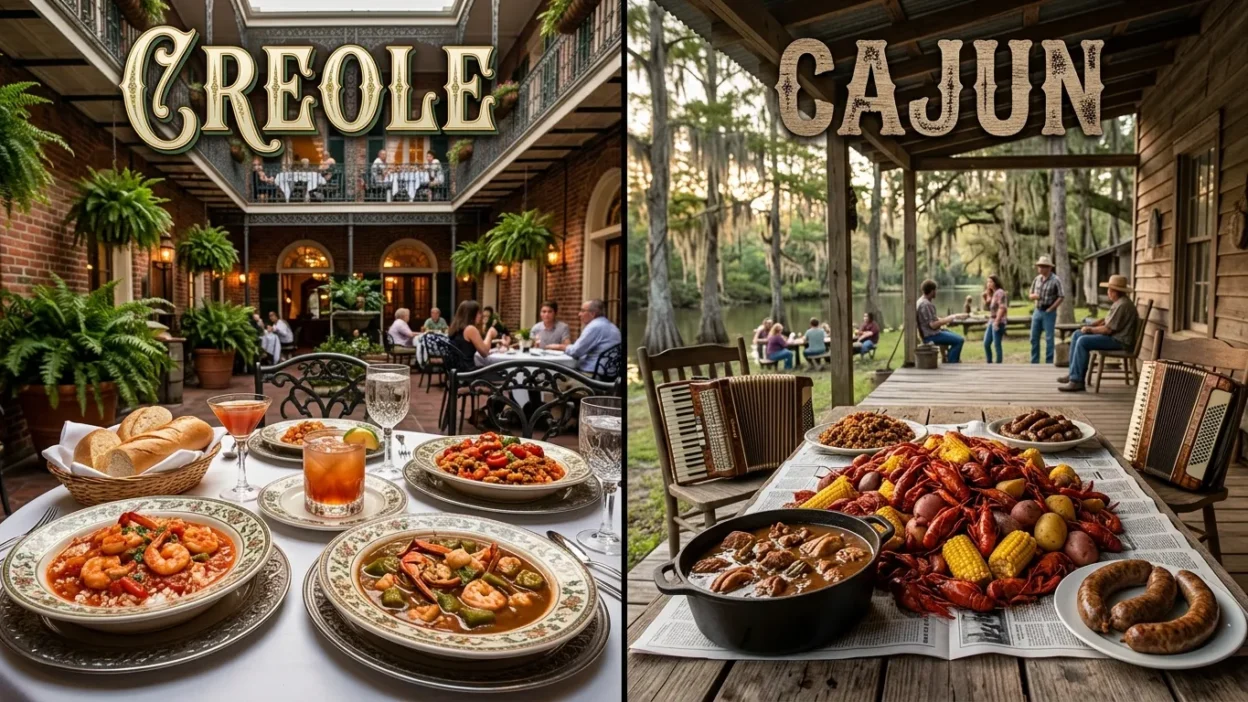
Creole and Cajun are two distinct but closely connected cultural traditions from Louisiana.
Cajun identity is strongly linked to the Acadian people who migrated from Canada to Louisiana, while Creole identity developed among Louisiana-born communities with diverse European, African, Caribbean, and Native American influences.
Their food, language, history, and traditions overlap, but each has its own distinctive heritage.
Key Takeaways
- Cajun culture traces much of its history to Acadian settlers who arrived in Louisiana after being displaced from Canada.
- Creole identity developed in colonial Louisiana and has included people of European, African, and mixed ancestry.
- Cajun cooking is often associated with hearty, rustic dishes, while Creole cuisine reflects the diverse cultural influences of New Orleans.
- Tomatoes are common in many Creole recipes, but they are not a perfect test for identifying a dish.
- Both traditions have influenced Louisiana’s food, music, language, festivals, and everyday life.
What Is the Difference Between Creole and Cajun?
The main difference between Creole and Cajun is their historical development and cultural identity. Cajun culture is closely associated with Acadian descendants in southern Louisiana. Creole culture emerged from the broader colonial society of Louisiana, shaped by several populations and traditions.
Although people often use these terms when discussing food, they describe more than cooking styles. They can refer to communities, family histories, languages, music, and cultural practices.
What Does Cajun Mean?
The word Cajun developed from Acadian, referring to French settlers who established communities in what is now eastern Canada. During the 18th century, many Acadians were forcibly displaced by British authorities. Some eventually reached Louisiana, where they adapted to a different climate, landscape, and way of life.
Their descendants developed a distinct regional identity influenced by French heritage, local ingredients, neighboring communities, and rural traditions. Today, Cajun culture is especially associated with Acadiana and other parts of southern Louisiana.
What Does Creole Mean?
The word Creole has a more complex history. In colonial Louisiana, it often described people born in the colony rather than overseas. Over time, its meaning developed differently across communities and historical periods.
Louisiana Creole identity has included people of European ancestry, African ancestry, and mixed heritage. French and Spanish colonial traditions, African cultural knowledge, Caribbean connections, and Native American influences all helped shape Creole communities.
Creole is therefore not simply another word for Black, mixed-race, or New Orleans resident. The meaning depends on historical and family context, geography, and how individuals identify themselves.
The Historic New Orleans Collection explains how Cajun and Creole identities developed together while becoming more distinct in modern Louisiana. (Read its historical overview).
Creole vs Cajun: Key Differences at a Glance
| Feature | Cajun | Creole |
| Historical roots | Acadian settlers and their descendants | Diverse Louisiana-born colonial communities |
| Cultural geography | Especially Acadiana and southern Louisiana | Strong historical connections to New Orleans and other Louisiana communities |
| Food traditions | Hearty dishes, smoked meats, rice, seafood, and roux-based cooking | Diverse sauces, seafood, tomatoes in many recipes, and varied culinary influences |
| Language | Cajun French and regional English varieties | Louisiana Creole language and other regional French varieties, depending on community |
| Music | Cajun music, often featuring fiddle and accordion | Creole musical traditions, including zydeco in some communities |
| Cultural identity | Often centered on Acadian heritage | Varies by community, ancestry, and family history |
These are broad patterns, not strict rules. Louisiana’s communities have interacted for generations, and individual families may share elements of both traditions.
Creole vs Cajun Food: How Are They Different?
Food is one of the easiest ways to explore the differences between Cajun and Creole traditions. Both cuisines use local seafood, rice, vegetables, spices, and techniques shaped by Louisiana’s environment. However, their historical influences and customary preparations can differ.
What Is Cajun Food?
<PRIVATE_PERSON> cooking is often described as rustic, resourceful, and hearty. Historically, many Cajun families lived in rural areas and relied on locally available ingredients, including crawfish, shrimp, fish, game, pork, and rice.
Common examples include:
- Boudin: A sausage typically made with pork, rice, and seasonings.
- Crawfish étouffée: A rich dish of crawfish covered in a seasoned sauce and served with rice.
- Cajun gumbo: A stew often built around a dark roux, meat or seafood, and vegetables.
- Jambalaya: A rice dish cooked with meat, seafood, vegetables, and seasonings.
- Smoked andouille sausage: A seasoned sausage used in many Louisiana dishes.
Cajun cooking often begins with the holy trinity of onion, celery, and bell pepper. Garlic, paprika, black pepper, cayenne, and herbs may add depth, but Cajun food is not always extremely spicy. Its defining quality is often the balance of seasoning and flavor.
What Is Creole Food?
Creole cuisine reflects the cultural diversity of Louisiana’s historic urban centers, especially New Orleans. French, Spanish, African, Caribbean, Native American, German, and Italian influences have all contributed to its development.
Creole cooking includes a wide range of dishes, from seafood preparations to elaborate sauces and rice-based meals.
Examples include:
- Shrimp Creole: Shrimp served in a seasoned sauce that commonly includes tomatoes.
- Creole gumbo: A varied stew that may combine seafood, meat, vegetables, okra, and roux.
- Red beans and rice: A New Orleans favorite with roots in the city’s food traditions.
- Creole jambalaya: A rice dish that commonly includes tomatoes alongside meat or seafood.
- Oysters Rockefeller: A famous New Orleans oyster dish associated with the city’s restaurant history.
Creole food is not necessarily fancier or milder than Cajun food. Both traditions range from simple home cooking to complex restaurant dishes.
Cajun Gumbo vs Creole Gumbo
Gumbo is a classic example of how the two cooking traditions overlap.
Cajun gumbo often features a dark roux, which adds a deep, toasted flavor. It may contain chicken, sausage, seafood, or game, depending on the cook and region.
Creole gumbo may feature seafood, okra, tomatoes in some versions, and a variety of seasonings. However, recipes vary widely, and many Creole gumbos do not contain tomatoes.
The important distinction is that there is no single ingredient that reliably separates every Cajun gumbo from every Creole gumbo. Family recipes, regional traditions, and individual preferences all matter.
Cajun Jambalaya vs Creole Jambalaya
The clearest traditional difference is the use of tomatoes.
Creole jambalaya, sometimes called red jambalaya, commonly includes tomatoes. Cajun jambalaya generally develops its darker color and flavor from browning the meat and vegetables rather than relying on tomatoes.
Both versions combine rice with ingredients such as sausage, chicken, shrimp, or other seafood. The exact combination depends on the recipe.
If you are ordering jambalaya at a Louisiana restaurant, asking about the preparation is more reliable than assuming every restaurant follows the same regional formula.
Differences in Language and Traditions
Cajun and Creole cultures are also connected to distinct language histories and musical traditions.
Language
Cajun French developed through the interaction of French varieties brought by settlers and the language traditions of Louisiana. Although English is widely spoken today, Cajun French remains an important symbol of cultural heritage.
Louisiana Creole, also known as Kouri-Vini, is a distinct French-based Creole language. It is not simply another name for Cajun French.
The two language traditions share some vocabulary and historical connections, but they have different linguistic histories. Louisiana State University provides an introduction to Cajun French.
Not every Cajun or Creole person speaks French or Louisiana Creole today. Language use varies across generations and families.
Music and Festivals
Cajun music is often associated with the fiddle, accordion, dance halls, and lively community gatherings. Traditional Cajun songs frequently reflect everyday life, family, love, and regional history.
Creole music includes several traditions, with zydeco especially associated with Black Creole communities in southwest Louisiana. Zydeco commonly features accordion and rhythm instruments, including the washboard-like frottoir.
The traditions overlap in instruments, performers, and audiences, but Cajun music and zydeco should not automatically be treated as the same genre.
Both communities also participate in regional festivals, Mardi Gras celebrations, family gatherings, and food-centered events that keep local traditions alive.
Where Do Cajun and Creole Cultures Come From?
Cajun and Creole cultures developed in the same broader region, but their histories followed different paths.
Acadian settlers arrived in Louisiana in the 18th century after displacement from Canada. They adapted to the local environment and interacted with Indigenous peoples, established French and Spanish communities, Africans, and other settlers. Their descendants developed the culture now widely recognized as Cajun.
Creole identity had already developed in colonial Louisiana. It reflected the lives of people born in the colony and the cultural exchange—often under unequal and violent colonial conditions—between European settlers, enslaved Africans, free people of color, Indigenous peoples, and later immigrant communities.
These histories are connected rather than completely separate. Some Acadian descendants also became part of Louisiana’s broader Creole world, while later social and political changes encouraged stronger distinctions between Cajun and Creole identities.
Understanding this history helps explain why simple labels based on race, location, or food can be misleading.
Are Creole and Cajun the Same?
No, Creole and Cajun are not identical, but their cultures overlap. Cajun identity is particularly connected to Acadian ancestry, while Creole identity developed among diverse communities born in colonial Louisiana.
The two traditions share regional influences, ingredients, language connections, and historical experiences. Some people identify strongly with one tradition, while others have family histories that connect them to both.
It is best to understand Cajun and Creole as distinct but interconnected parts of Louisiana’s cultural heritage rather than as opposing categories.
FAQs:
Is Cajun food spicier than Creole food?
Cajun food is often associated with bold seasoning, but it is not always hotter than Creole food. Both cuisines use herbs, spices, and peppers in different amounts. The flavor depends on the recipe and cook, so the word Cajun alone does not guarantee a spicy dish.
Is jambalaya Cajun or Creole?
Jambalaya belongs to both traditions. Creole jambalaya commonly contains tomatoes, while Cajun jambalaya usually does not. Both versions combine rice with seasoned vegetables and ingredients such as chicken, sausage, or seafood. Local customs and individual recipes can create exceptions to these general patterns.
Do Cajun and Creole people speak French?
Some do, but not everyone. Cajun French is associated with Cajun communities, while Louisiana Creole is a distinct language with its own history. English is widely spoken throughout Louisiana, and the use of French and Creole varies by family, community, and generation.
Is New Orleans Cajun or Creole?
New Orleans has a strong Creole history, but its culture is not exclusively Creole. The city also includes Cajun influences and many other cultural traditions. Cajun heritage is especially associated with Acadiana and southwest Louisiana, while Creole communities exist throughout the state, including outside New Orleans.
Conclusion:
Understanding Creole vs Cajun means looking beyond a simple food comparison. Cajun culture has deep connections to Acadian ancestry, while Creole identity reflects the diverse communities that shaped colonial and modern Louisiana.
Their cuisines offer useful clues, from Cajun jambalaya’s traditional lack of tomatoes to the tomato-rich sauces found in many Creole dishes. But food is only one part of a much larger story.
Both traditions continue to shape Louisiana’s language, music, celebrations, and sense of place. Learning about their shared history and distinct identities is the best way to appreciate what makes each one special.

I am C.S. Lewis, a British writer, scholar, and Christian thinker best known for The Chronicles of Narnia and his influential works on Christian faith.
My writing continues to inspire readers around the world through timeless stories, faith, and thoughtful ideas.
For more author information and inspiring names, visit Elitenamez.com.