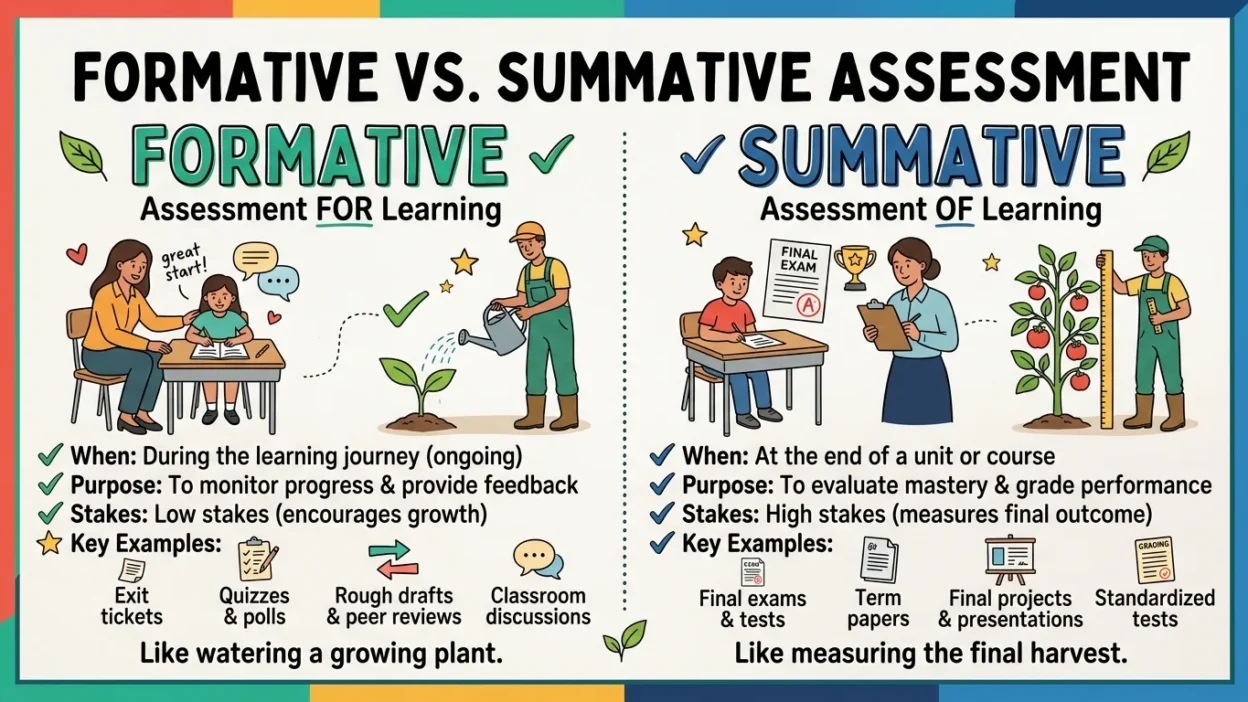
Formative vs summative assessment comes down to purpose and timing. Formative assessment checks student understanding during the learning process so teachers can provide feedback and adjust instruction.
Summative assessment evaluates what students have learned after a lesson, unit, or course. Both help teachers measure progress and support better educational outcomes.
Key Takeaways
- Formative assessment helps teachers identify learning gaps while students are still learning.
- Summative assessment measures achievement at the end of a learning period.
- Examples of formative assessment include practice quizzes, exit tickets, and classroom discussions.
- Examples of summative assessment include final exams, end-of-unit tests, and major projects.
- Using both approaches gives teachers a more complete picture of student progress.
What Is Formative Assessment?
Formative assessment is a process teachers use to check student understanding during instruction. Its primary purpose is to identify what students understand, where they struggle, and what they need to learn next.
Instead of waiting until the end of a unit, teachers gather evidence of learning throughout lessons. They use that information to explain difficult concepts again, change teaching strategies, or provide additional practice.
Formative assessment is often called assessment for learning because it helps students improve before their learning is formally evaluated.
For example, a fifth-grade teacher might ask students to solve three fraction problems before the lesson ends. If many students make the same mistake, the teacher can review that concept in the next class.
The goal is not simply to assign a grade. It is to make learning more effective.
Examples of Formative Assessment
Teachers can use many simple strategies to monitor student understanding.
- Exit tickets: Students answer a short question before leaving class.
- Practice quizzes: Students answer questions to identify concepts they need to review.
- Class discussions: Teachers ask questions and listen to students explain their thinking.
- Think-pair-share: Students discuss a problem with a partner before sharing their answers.
- Draft assignments: Students submit early versions of essays or projects for feedback.
- Self-assessment: Students reflect on their progress and identify areas for improvement.
- Peer feedback: Students review one another’s work using clear criteria.
For instance, an English teacher might ask students to write a paragraph using a newly learned grammar rule. After reviewing their responses, the teacher can address common mistakes before the final writing assignment.
Benefits of Formative Assessment
Formative assessment offers several benefits for both teachers and students.
1. Identifies learning gaps early
Teachers can spot misunderstandings before they become larger problems.
2. Provides timely feedback
Students learn what they are doing well and what they need to improve.
3. Supports personalized instruction
Teachers can adjust activities to meet different learning needs.
4. Encourages student participation
Frequent opportunities to respond help students become active participants in their education.
5. Reduces surprises on major tests
Regular checks give students opportunities to practice and correct mistakes before final evaluations.
Formative assessment works best when teachers use the results to make meaningful changes rather than simply collecting answers.
What Is Summative Assessment?
Summative assessment evaluates student learning after a defined period of instruction, such as a unit, semester, or school year.
Its purpose is to determine how well students have achieved specific learning objectives. Results may contribute to final grades, course completion decisions, or reports of academic achievement.
Summative assessment is commonly described as assessment of learning because it measures what students have learned at a particular point.
For example, after teaching a unit on the American Revolution, a teacher might give students a test covering major events, important figures, and historical causes.
Unlike a typical formative check, this test may contribute directly to the student’s unit grade.
However, summative assessment is not limited to traditional exams. Teachers can also evaluate presentations, portfolios, research papers, and completed projects.
Examples of Summative Assessment
Common examples include:
- Final exams: Tests that evaluate learning across a course or semester.
- End-of-unit tests: Assessments covering the main objectives of a completed unit.
- Research papers: Written assignments that demonstrate subject knowledge and analytical skills.
- Final projects: Completed products evaluated against a rubric.
- Oral presentations: Presentations that measure knowledge and communication skills.
- Standardized tests: Assessments designed to measure performance against established standards.
- End-of-course assessments: Evaluations used to determine whether students have met course expectations.
For example, a science class might complete a project explaining an ecosystem. The teacher could grade the project based on scientific accuracy, evidence, organization, and understanding of the learning objectives.
Benefits of Summative Assessment
Summative assessment provides important information about academic achievement.
1. Measures learning outcomes
Teachers can determine whether students have met expected objectives.
2. Supports grading decisions
Results can contribute to report cards, course grades, and academic records.
3. Shows overall performance
Teachers can identify how well students performed after completing a learning unit.
4. Helps evaluate instruction
Results may reveal topics that students found especially challenging.
5. Communicates progress
Schools and families can use assessment results to understand student achievement.
One limitation is that summative results often arrive after the main learning period has ended. Students may have fewer opportunities to correct misunderstandings within that same unit.
Formative vs Summative Assessment: Key Differences
The main difference between formative and summative assessment is how teachers use the information they collect.
Formative assessment supports improvement during learning, while summative assessment evaluates achievement after a period of learning.
| Feature | Formative Assessment | Summative Assessment |
|---|---|---|
| Main purpose | Improve learning | Measure achievement |
| Timing | During instruction | At the end of a learning period |
| Common name | Assessment for learning | Assessment of learning |
| Feedback | Usually timely and actionable | Often provided after evaluation |
| Grading | Often ungraded or low-stakes | Often graded or higher-stakes |
| Teacher’s role | Adjust teaching and provide support | Evaluate learning outcomes |
| Student’s role | Practice, reflect, and improve | Demonstrate acquired knowledge |
| Examples | Exit tickets, practice questions, drafts | Final exams, completed projects, unit tests |
These differences describe common practices, not strict rules. A formative assessment can receive a grade, and a summative assessment can provide feedback that helps students improve in the future.
A Simple Classroom Example
Imagine a teacher is teaching students how to write persuasive essays.
During the unit, students submit introductions and receive feedback on their arguments. This is formative assessment because the feedback helps them improve their work.
At the end of the unit, students submit a complete persuasive essay for evaluation against a rubric. This is summative assessment because it measures their achievement after instruction.
Both assessments focus on the same skill, but they serve different purposes.
Is a Quiz Formative or Summative?
A quiz can be formative or summative. The purpose of the quiz, rather than its format, determines its role.
A short quiz used to identify misunderstandings and guide the next lesson is formative. A quiz given at the end of a unit to calculate a student’s achievement grade is summative.
Consider these examples:
- A teacher gives five practice questions and reviews the answers with the class. This is formative.
- A teacher gives a graded test after completing a chapter to evaluate mastery. This is summative.
- A teacher uses a quiz score to decide which students need extra support before the final exam. This is formative in purpose, even if the quiz also receives a grade.
Teachers should decide what they want to learn from an assessment before choosing its format. This makes the results more useful for both instruction and evaluation.
Can Teachers Use Both Types of Assessment?
Yes. Formative and summative assessments work best as complementary parts of a well-planned learning process.
Formative assessment helps teachers guide learning as it happens. Summative assessment shows what students have achieved after instruction.
For example, a teacher planning a three-week mathematics unit might follow this process:
Week 1: Introduce and practice
Teach the core concepts and use short practice questions to check understanding.
Assessment: Formative
Week 2: Review and improve
Analyze student responses, provide feedback, and reteach difficult topics.
Assessment: Formative
Week 3: Evaluate learning
Give an end-of-unit test or project that measures progress toward the learning objectives.
Assessment: Summative
This approach gives students multiple opportunities to learn and improve before a major evaluation.
It also helps teachers understand why students struggle, rather than relying only on a final score.
How to Choose the Right Assessment
The right assessment depends on your learning goal and when you need the information.
Choose formative assessment when you want to:
- Check understanding during a lesson.
- Identify misconceptions before moving forward.
- Provide feedback while students can still revise their work.
- Adjust your teaching strategy.
- Encourage reflection and independent learning.
Choose summative assessment when you want to:
- Measure achievement after instruction.
- Evaluate whether learning objectives have been met.
- Assign a final grade for a unit or course.
- Document overall academic performance.
- Assess a completed project or final product.
Before creating an assessment, ask yourself: Do I want to improve learning right now, or measure what students have learned?
If the answer is to improve learning, a formative approach is usually appropriate. If the answer is to evaluate completed learning, a summative approach is generally the better fit.
Remember that a well-designed assessment should match the learning objectives. A multiple-choice test may work for checking factual knowledge, while a presentation or project may better demonstrate communication, research, or problem-solving skills.
FAQs:
1. Which assessment is better for student learning?
Both types are valuable, but formative assessment is especially useful for guiding improvement during instruction. It helps teachers identify learning gaps and provide timely feedback. Summative assessment measures what students have achieved after instruction. Using both gives teachers a clearer understanding of student progress and final learning outcomes.
2. Is homework a formative or summative assessment?
Homework can serve either purpose. Practice homework that helps a teacher identify misunderstandings is formative. A major graded assignment used to evaluate completed learning may be summative. The distinction depends on the assignment’s purpose and how the teacher uses its results.
3. Are standardized tests summative assessments?
Standardized tests are often summative when they measure achievement against established learning standards after instruction. However, their purpose can vary. Some standardized assessments help identify learning needs or guide future instruction, so not every standardized test serves only a summative role.
4. Can one assessment serve both purposes?
Yes. A graded quiz might measure current achievement while also revealing topics that need additional instruction. In that situation, the quiz has a summative function for grading and a formative function when its results guide future learning. Assessment purposes can overlap.
Conclusion:
Understanding formative vs summative assessment helps teachers make better decisions about instruction, feedback, and student achievement.
Formative assessment identifies learning needs and supports improvement while instruction is taking place. Summative assessment evaluates what students have learned after a lesson, unit, or course.
Neither approach replaces the other. Formative assessments help students prepare, practice, and correct mistakes, while summative assessments show how well they have met learning objectives.
For the best results, teachers should combine both approaches, align assessments with learning goals, and use the information to support meaningful student progress.

I am Paulo Coelho, a Brazilian author best known for inspiring readers through stories about dreams, faith, and personal journeys.
I share my writing experience and insights on Elitenamez.com to help readers discover meaningful ideas and stories.