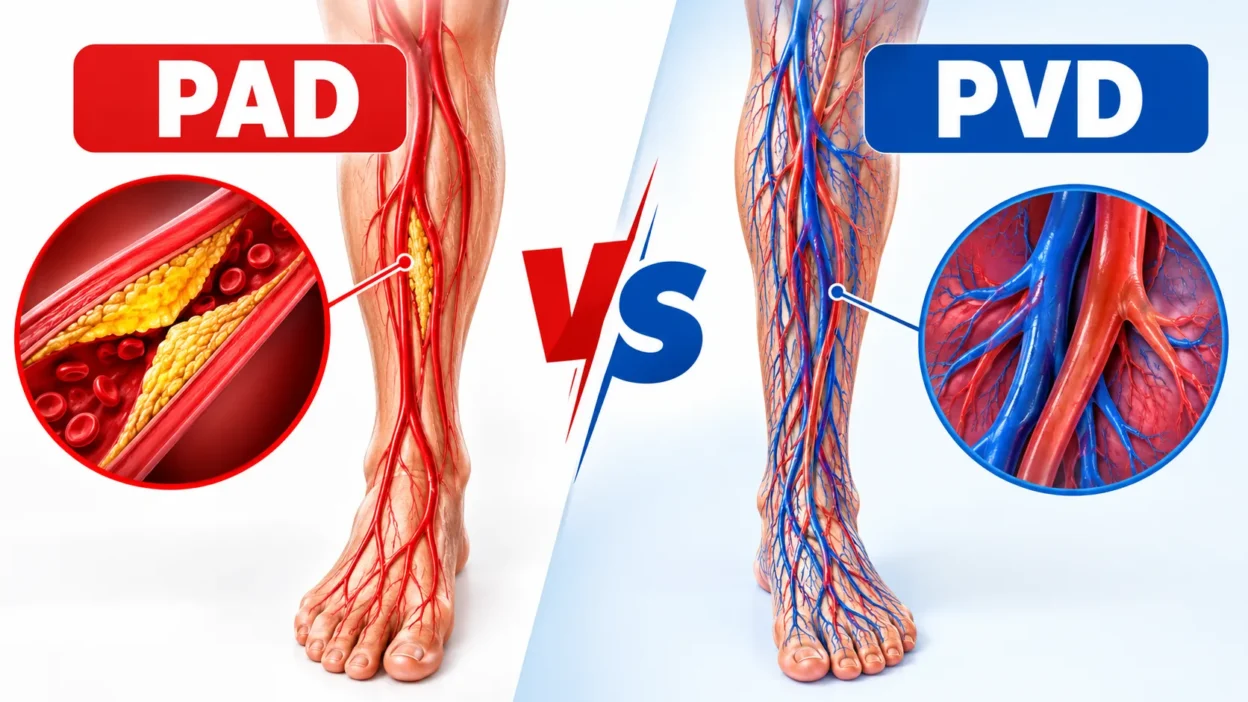
PAD vs PVD: Peripheral artery disease (PAD) specifically affects arteries, usually because plaque narrows blood flow to the legs.
Peripheral vascular disease (PVD) is a broader term that can include diseases of arteries and veins.
Some sources also use PVD to mean peripheral venous disease, so the exact meaning matters when comparing the two.
Key Takeaways
- PAD affects arteries and commonly results from atherosclerosis.
- PVD is a broader term for blood-vessel disease outside the heart and brain.
- Some sources use PVD to mean venous disease, which can cause swelling and heaviness.
- PAD often causes leg pain with walking that improves with rest.
- Venous disease more often causes swelling, heaviness, aching, and skin changes.
- Diagnosis and treatment depend on which blood vessels are affected.
What Is the Difference Between PAD and PVD?
The biggest difference between PAD vs PVD is that PAD has a specific meaning, while PVD can have more than one meaning.
PAD stands for peripheral artery disease. It occurs when arteries outside the heart and brain become narrowed or blocked. The legs and feet are commonly affected.
PVD stands for peripheral vascular disease. Technically, it is a broader term that can describe problems involving blood vessels outside the heart and brain. Depending on the source, it can include arterial and venous conditions.
This is where the confusion starts. In some nursing and patient-education materials, PVD is also used to mean peripheral venous disease. That is not the same thing as PAD.
So, before comparing the two acronyms, it is important to determine what the writer or healthcare professional means by “PVD.”
What Is Peripheral Artery Disease (PAD)?
Peripheral artery disease occurs when arteries supplying the limbs become narrowed or blocked. Atherosclerosis, or plaque buildup inside artery walls, is the most common cause of lower-extremity PAD.
When an artery becomes narrowed, less oxygen-rich blood reaches the muscles and tissues. The problem may become especially noticeable during exercise because working muscles need more oxygen.
One classic symptom is intermittent claudication. This means aching, cramping, fatigue, or discomfort in the leg muscles during walking or other activity that improves with rest.
PAD can also be present without typical pain. Other possible signs include a cool foot, changes in skin color, reduced hair growth, numbness, weak pulses, and wounds that heal slowly.
Common PAD Symptoms
Possible symptoms include:
- Leg pain or cramping while walking
- Pain that improves after resting
- Leg or foot numbness
- Weakness or fatigue
- Cool skin on the affected foot
- Pale or other color changes
- Reduced hair growth
- Slow-growing toenails
- Foot or leg wounds that heal poorly
- Weak or absent pulses in advanced disease
Severe PAD can cause pain even when a person is resting and can lead to serious problems involving tissue damage or limb-threatening ischemia.
What Causes PAD?
PAD most often develops from atherosclerosis, in which fatty plaque builds up inside an artery.
Risk factors include smoking, diabetes, high blood pressure, high cholesterol, older age, and other forms of cardiovascular disease.
The condition is important beyond the legs because PAD is associated with a higher risk of cardiovascular events such as heart attack and stroke.
The 2024 ACC/AHA guideline recommends comprehensive management that can include risk-factor control, appropriate antiplatelet or antithrombotic therapy, lipid-lowering treatment, blood-pressure and diabetes management, smoking cessation, exercise, and revascularization when clinically appropriate.
What Does PVD Mean?
PVD means peripheral vascular disease when the acronym is being used in its broad sense.
“Peripheral” means away from the central circulation, while “vascular” refers to blood vessels. Therefore, PVD can describe several disorders affecting vessels outside the heart and brain.
In this broad definition, PAD can be considered one type of peripheral vascular disease.
However, some sources use PVD specifically for peripheral venous disease. Venous disease involves veins rather than arteries.
PVD as Peripheral Vascular Disease
When PVD means peripheral vascular disease, it is an umbrella term.
It can involve:
- Arteries
- Veins
- Other peripheral blood vessels
That means saying someone has “PVD” does not always tell you exactly which vessel is affected.
For clearer medical communication, PAD is often preferred when the problem specifically involves the peripheral arteries.
PVD as Peripheral Venous Disease
When PVD is being used to mean peripheral venous disease, the problem is different from PAD.
A common example is chronic venous insufficiency. In this condition, damaged or poorly functioning vein valves make it harder for blood to return from the legs toward the heart. Blood can pool in the lower legs.
This can lead to swelling, heaviness, aching, itching, varicose veins, skin discoloration, and sometimes ulcers.
PAD vs PVD Symptoms: Side-by-Side Comparison
When PVD means venous disease, the symptom pattern is usually quite different from PAD.
| Feature | PAD | Venous PVD |
|---|---|---|
| Main vessel | Arteries | Veins |
| Main problem | Reduced blood flow to tissues | Blood pooling and poor return to heart |
| Typical pain | Cramping or aching with activity | Dull, heavy, aching discomfort |
| Effect of walking | Pain may appear with activity | Walking may help venous circulation |
| Effect of elevation | May worsen severe arterial pain | Often reduces swelling |
| Swelling | Usually not the main feature | Common |
| Skin | May become cool, pale, thin, or shiny | May become darker, thickened, or irritated |
| Pulses | May be weak or absent | Often preserved, depending on the condition |
| Common wound area | Feet or toes | Lower leg and ankle area |
| Common diagnostic focus | ABI and arterial testing | Duplex ultrasound and venous evaluation |
This table shows general patterns, not a diagnostic checklist. Many conditions can cause leg pain, swelling, numbness, or skin changes.
PAD vs PVD: Causes and Risk Factors
PAD and venous disease can share some risk factors, but their underlying mechanisms are different.
PAD is strongly associated with atherosclerosis and cardiovascular risk factors. Smoking, diabetes, high blood pressure, high cholesterol, and age can increase risk.
Venous disease is more closely related to problems with venous valves and blood returning from the legs. Risk factors can include prolonged sitting or standing, obesity, pregnancy, previous deep vein thrombosis, and a history of vein problems.
A person can also have both arterial and venous disease. That is one reason a healthcare professional may need to assess circulation carefully instead of assuming that swelling or leg pain has only one cause.
How Are PAD and PVD Diagnosed?
Diagnosis depends on the suspected vessel and the person’s symptoms.
A healthcare professional may begin with a medical history and physical examination. They may ask when symptoms occur, whether walking triggers pain, whether elevation changes symptoms, and whether there are wounds, swelling, color changes, or temperature differences.
ABI for PAD
The ankle-brachial index (ABI) is a common noninvasive test for PAD.
It compares blood pressure measured at the ankle with blood pressure measured in the arm. A lower-than-normal result can indicate reduced arterial blood flow.
The American Heart Association notes that an ABI of 0.90 or lower is abnormal, while values above 1.40 may indicate arteries that are difficult to compress and require additional assessment.
Additional testing may include Doppler waveforms, toe-brachial index testing, duplex ultrasound, CT angiography, or magnetic resonance angiography, depending on the situation.
Duplex Ultrasound for Venous Disease
When venous disease is suspected, a duplex ultrasound can help evaluate blood flow and the structure of the veins.
For chronic venous insufficiency, healthcare professionals may look for abnormal blood flow caused by poorly functioning valves or other changes in the veins.
The important point is that there is no single “PVD test” that diagnoses every condition described by that acronym.
PAD vs PVD Treatment
Treatment depends on the actual diagnosis.
For PAD, treatment may focus on reducing cardiovascular risk and improving blood flow. This can include smoking cessation, exercise therapy, cholesterol management, blood-pressure and diabetes control, medications, and—in selected cases—procedures such as angioplasty or bypass surgery.
For venous disease, treatment may include leg elevation, regular physical activity, compression therapy when appropriate, and treatment of the affected veins. Procedures may be considered for some people with significant venous disease.
Compression deserves special attention. Compression can be useful for venous problems, but people with significant PAD may need a different approach. A healthcare professional should assess arterial circulation before using significant compression when PAD is suspected.
Can You Have PAD and Venous Disease at the Same Time?
Yes. A person can have both arterial and venous circulation problems.
This matters because symptoms can overlap. For example, someone may have leg discomfort and swelling, but those symptoms alone do not establish whether the problem is arterial, venous, lymphatic, musculoskeletal, or another condition.
If both conditions are present, treatment needs to account for both. For example, compression therapy that may help venous disease may require special precautions when arterial blood flow is reduced.
When Should You Seek Medical Care?
Recurring leg pain during walking, unexplained circulation changes, or a wound that does not heal should be evaluated by a healthcare professional.
Seek prompt medical attention for worsening symptoms, new pain at rest, or a foot or leg that becomes unusually cold, pale, blue, or numb.
Sudden severe leg pain with a cold or pale limb, loss of pulses, numbness, or weakness can be an emergency. Acute limb ischemia can threaten the limb and requires urgent medical evaluation.
Do not try to determine PAD or PVD from symptoms alone.
Frequently Asked Questions
Are PAD and PVD the same thing?
Not always. PAD specifically means peripheral artery disease and involves arteries. PVD usually means peripheral vascular disease, which is a broader term that can include arterial and venous disorders. Some educational sources use PVD to mean peripheral venous disease. Always check how the acronym is being defined.
What are the first signs of PAD?
A common early symptom is leg discomfort, cramping, or fatigue during walking that improves with rest. However, some people with PAD have no typical symptoms. Other possible signs include cool feet, skin changes, numbness, reduced hair growth, weak pulses, and slow-healing wounds.
Can PVD cause leg swelling?
Yes, if PVD is being used to describe venous disease. Conditions such as chronic venous insufficiency can cause swelling around the ankles and lower legs, particularly after prolonged standing. However, swelling can have many causes, so it should not automatically be attributed to PVD.
Is compression therapy safe if you have PAD?
Compression therapy is commonly used for venous disease, but significant PAD can change whether compression is appropriate and how much compression is safe. If PAD is suspected or diagnosed, a healthcare professional should assess arterial circulation before starting compression therapy.
Conclusion
The simplest way to understand PAD vs PVD is to remember that PAD specifically involves arteries, while PVD can be a broader term for peripheral blood-vessel disease.
If PVD is being used to mean venous disease, the contrast becomes clearer: PAD reduces arterial blood flow, while venous disease can cause blood to pool in the legs.
Because the acronyms are used inconsistently, the safest approach is to identify the actual vessel and underlying condition before choosing treatment.

I am Maya Angelou, a celebrated American author, poet, and civil rights activist known for my powerful writing and inspiring life story.
My work continues to influence readers around the world through its themes of courage, identity, and resilience. Learn more about my life and work at Elitenamez.com.